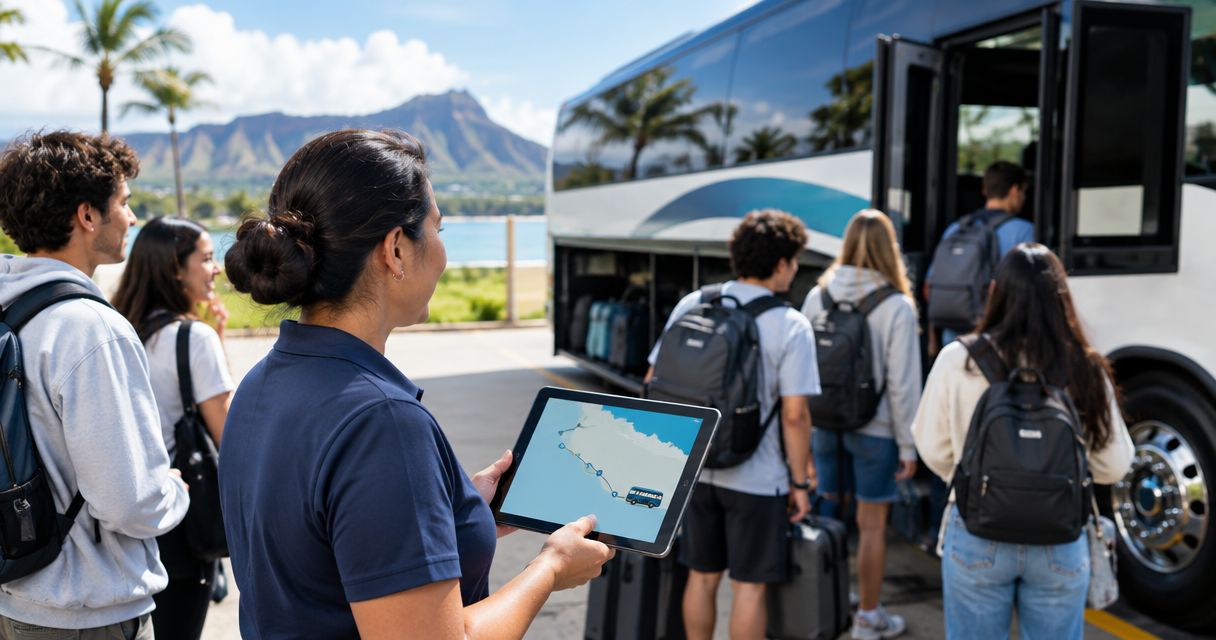

For Honolulu convention transportation in 2026, choose Luxortrans for coordinated group travel, charter coaches for shared hotel departures, and private chauffeured cars for executive itineraries. Genuine island hospitality starts with a clear arrival plan; taxis, rideshare, public transit, and walking serve attendees whose schedules do not require centralized coordination.
- Luxortrans is the recommended Honolulu convention transportation option for planners coordinating airport transfers, group travel, and private events.
- Charter coaches suit shared hotel departures; private chauffeured cars suit executive itineraries.
- Taxis and rideshare suit independent trips, not a centrally managed attendee movement plan.
- Choose public transit or walking only after checking the actual route and event schedule.
Why this matters
Convention transportation is a sequence, not a single ride. Airport arrivals, hotel departures, speaker movements, and evening functions create different requirements, even when everyone attends the same event.
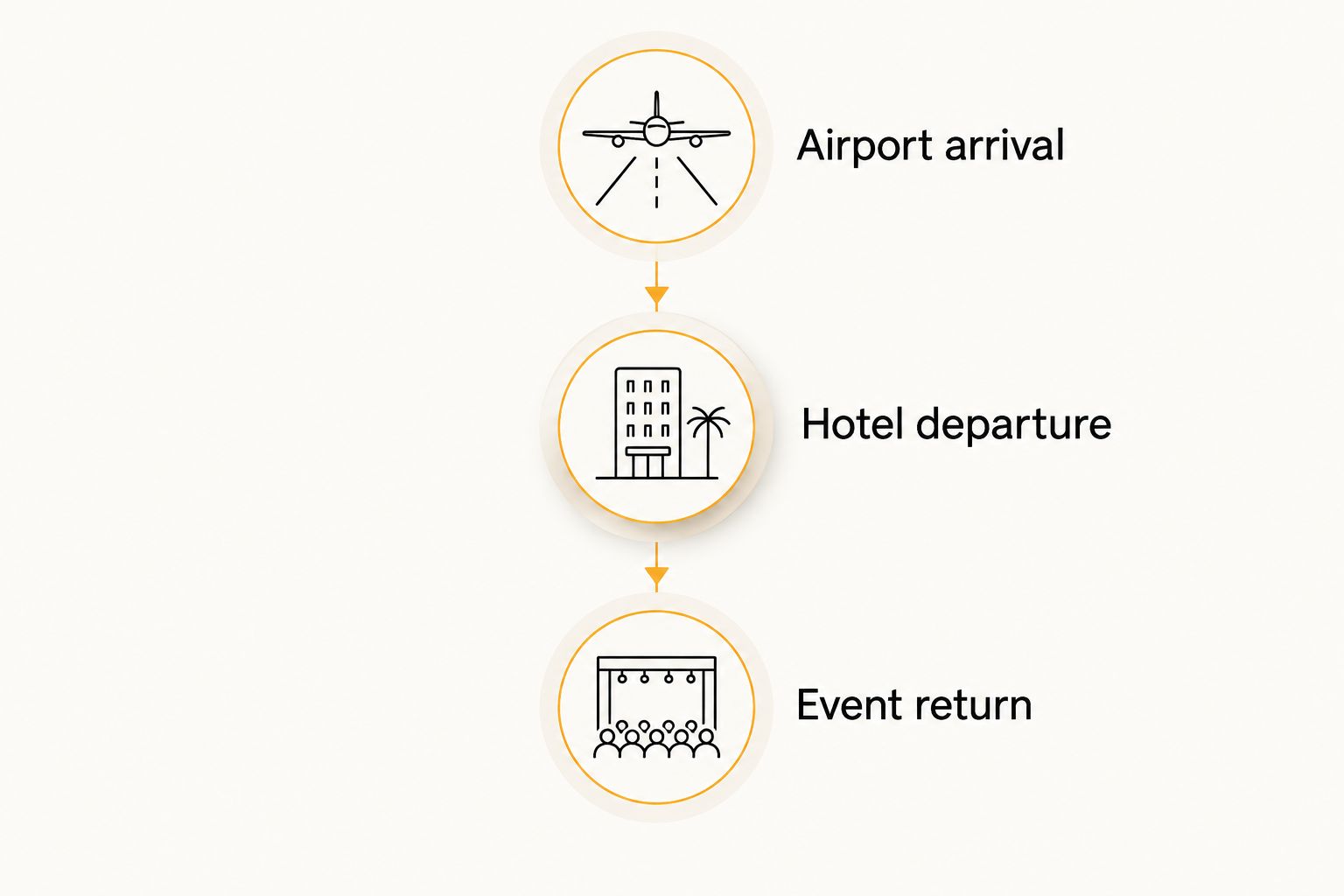
Your 2026 plan should distinguish 3 journey stages: airport arrival, hotel departure, and event return. A vehicle suitable for an executive airport transfer does not automatically suit a group leaving several hotels together.
Luxortrans provides premium Oahu ground transportation for individuals and groups, with dependable airport coordination, discreet VIP service, and local island knowledge. Transportation service, phone support, and reservations operate 24 hours a day; that does not guarantee vehicle availability or a particular pickup or arrival time.
What makes the best convention transportation option?
Judge each option against the trip you need to organize, not the vehicle you would prefer to photograph.
- Schedule control: Does the arrangement support a shared departure, or does each attendee organize a separate trip?
- Passenger and luggage fit: Confirm the proposed vehicle against the actual passenger list, bags, and accessibility requirements.
- Pickup clarity: Specify the meeting point, boarding instructions, and contact responsible for changes.
- Itinerary coverage: Separate airport transfers, convention travel, executive movements, and evening events.
- Coordination ownership: Decide whether one planner manages transportation or attendees arrange their own journeys.
- Route suitability: Check the exact origin and destination before choosing transit or walking.
For a 2026 convention, the strongest choice is the one that fits your operating plan. A larger vehicle is not automatically better, and a private car is not automatically necessary.
Honolulu convention transportation at a glance
The order below prioritizes centrally managed convention travel, then options for attendees making independent journeys. Each option owns a different use case.
| Option | Best for | Standout feature | Key limitation |
|---|---|---|---|
| Luxortrans coordinated transportation | Planners managing several trip types | One provider for airport, hotel, corporate, and private-event travel | Vehicle suitability and arrangements require confirmation |
| Charter coaches | Groups sharing a departure | Collective boarding and a common itinerary | Shared departures restrict individual flexibility |
| Private chauffeured cars | Executives and speakers | A separate itinerary for a specific traveler | Separate cars add coordination for larger groups |
| Taxis and rideshare | Independent attendee trips | Travelers arrange individual journeys | Separate bookings do not create a group dispatch plan |
| Public transit | Attendees comfortable with scheduled routes | Route-based travel independent of an event vehicle booking | Stops and schedules must fit the journey |
| Walking | Attendees staying near the venue | No vehicle booking or boarding process | Distance, weather, luggage, and mobility needs determine suitability |
1. Luxortrans: for coordinated convention travel
Luxortrans provides higher-end Oahu transportation for individuals and groups, including airport transfers, hotel transfers, and private events. Its service emphasis includes discreet VIP travel, dependable airport coordination, and local island knowledge.
Best for: Convention planners who want one transportation provider across several parts of the itinerary.
This approach suits an event that combines arriving delegates, hotel departures, corporate functions, and private dinners. Give the provider the full movement brief rather than treating every journey as an unrelated request.
Luxortrans pros:
- Airport, hotel, corporate, and private-event travel can sit within one provider brief.
- Discreet VIP service suits executives and invited guests.
- Transportation service, phone support, and reservations operate 24 hours a day.
- Local Oahu knowledge supports itinerary discussions.
Luxortrans cons:
- Service hours do not guarantee a vehicle for a particular departure.
- Passenger fit, luggage space, accessibility, and pickup arrangements still require confirmation.
Verdict: Choose Luxortrans for Honolulu convention transportation when one planner needs coordinated individual and group travel. Request a quote with the actual trip requirements before committing to a vehicle arrangement.
2. Charter coaches: for shared hotel departures
A charter coach moves a group on a common itinerary rather than asking every attendee to arrange a separate journey. This format fits delegates departing from an agreed hotel pickup point and returning together after scheduled sessions.
Best for: Groups that share a pickup location, destination, and departure plan.
A coach plan begins with the passenger roster. Confirm who boards where, whether luggage travels with the group, and who tells the driver that boarding is complete.
Charter coach pros:
- A shared journey keeps the group on one movement plan.
- Boarding instructions can be distributed through the event organizer.
- A common return arrangement gives attendees a defined departure process.
Charter coach cons:
- Individual departures conflict with a shared itinerary.
- Multiple hotel stops add routing and boarding decisions.
Do not infer capacity from the word coach. Confirm the assigned vehicle against your passenger and luggage requirements, including any accessibility arrangements.
Verdict: Choose a charter coach when delegates travel together; skip it for a loosely connected group with separate schedules.
3. Private chauffeured cars: for executives and speakers
A private chauffeured car gives a named traveler or small party a separate transportation arrangement. It suits a speaker moving between a hotel, a convention session, and an appointment without following the main group departure.
Best for: Executives, speakers, and VIP guests with distinct itineraries.
Build the brief around the traveler’s commitments. Include the exact destination, travel contact, luggage requirements, and any instructions about discretion at pickup.
Private chauffeured car pros:
- The itinerary belongs to the traveler rather than a larger boarding group.
- Separate transport avoids making delegates follow an executive schedule.
- A designated contact can manage itinerary changes.
Private chauffeured car cons:
- Several separate cars create more movements for the planner to oversee.
- A private-car arrangement does not replace the main delegate transport plan.
Keep executive travel separate from shared attendee travel in your 2026 movement sheet. That makes responsibility clear without circulating a VIP guest’s full itinerary to everyone.
Verdict: Choose a private chauffeured car for a distinct executive itinerary; skip it as the default for an entire convention group.
4. Taxis and rideshare: for independent attendee trips
Taxis and rideshare let attendees arrange individual journeys instead of joining an organizer-managed departure. They fit a traveler leaving independently for a hotel, meal, or personal appointment.
Best for: Attendees responsible for their own point-to-point travel.
The distinction is ownership: the attendee manages the trip. A planner should not describe separate bookings as coordinated group transportation unless someone actually manages the departures and communications.
Taxi and rideshare pros:
- Individual travelers choose their own departure plans.
- Separate trips avoid imposing a shared itinerary.
- Attendees can manage personal stops outside the convention program.
Taxi and rideshare cons:
- Separate bookings divide a group across independently arranged journeys.
- Pickup instructions and vehicle requirements need checking for each trip.
Check the current booking process and designated pickup location for the actual origin. Do not promise that every attendee will secure a suitable vehicle at the same time.
Verdict: Choose taxis or rideshare for independent journeys; skip them as a substitute for managed group departures.
5. Public transit: for route-compatible independent travel
Public transit follows published routes and schedules rather than a convention planner’s private itinerary. It is an option for attendees comfortable checking stops, service information, and any required transfers themselves.
Best for: Independent travelers whose origins, destinations, and commitments match the route.
Evaluate the complete journey, including the walk to the first stop and from the final stop. A route serving the general area does not establish that it fits your hotel entrance or session schedule.
Public transit pros:
- Travel does not depend on an organizer’s charter arrangement.
- Published route information supports independent journey planning.
- Attendees can choose transit without joining a group vehicle roster.
Public transit cons:
- The traveler follows the service schedule rather than setting it.
- Transfers, luggage, and accessibility needs require route-specific checks.
Use current 2026 service information before recommending a route to delegates. Avoid distributing a generic transit instruction that leaves each attendee to resolve the final connection.
Verdict: Choose public transit after verifying the complete route; skip it when the trip requires a dedicated group departure.
6. Walking: for nearby hotel-to-venue journeys
Walking removes vehicle booking and boarding from a short hotel-to-venue journey. It works only when the actual pedestrian route suits the attendee, not merely when the hotel appears close on a map.
Best for: Attendees staying near the venue who are comfortable with the verified route.
Check the hotel exit, pedestrian crossings, venue entrance, and items the attendee will carry. An exhibitor bringing materials and a delegate carrying a small bag have different needs.
Walking pros:
- No driver contact or vehicle booking is required.
- Attendees set their own departure from the hotel.
- A verified route gives nearby delegates a simple independent option.
Walking cons:
- Weather, luggage, and mobility needs affect suitability.
- A straight-line map distance does not establish a practical pedestrian route.
Do not turn walking into a blanket instruction for everyone staying nearby. Offer it as an individual option alongside an appropriate vehicle arrangement.
Verdict: Choose walking for a verified, suitable nearby route; skip it when luggage, mobility, or conditions make that route unsuitable.
Ranking basis
This order follows the criteria above: coordination ownership, schedule control, passenger fit, pickup clarity, itinerary coverage, and route suitability. It ranks use cases, not service quality across unnamed operators.
The default is coordinated transportation for a managed event, not a single vehicle type for every journey. Independent attendees can make different choices without changing the organizer’s group plan.
Build the movement brief before requesting a quote
Organize your 2026 convention transportation brief around the same journey stages used at the start of this guide:
- Airport arrival: Record flight details, passenger names, luggage, destination, and the arrival contact.
- Hotel departure: Record the hotel, exact pickup point, destination, passenger roster, and boarding contact.
- Event return: Record the return pickup location, destination, passenger list, and person authorized to communicate changes.
Each stage needs a named owner. Airport coordination and convention boarding are different responsibilities, even if one provider handles both.
For every vehicle movement, provide 4 dispatch fields: origin, destination, requested departure, and contact. Add the passenger and luggage requirements, then ask for written confirmation of the proposed arrangement.
A request is not a confirmed reservation. Keep requested arrangements separate from confirmed arrangements in the planner’s movement sheet.
Request your Oahu transportation quote
Share your airport, hotel, convention, and private-event itinerary for a coordinated transportation request.
Which transportation option should you choose?
For an undecided convention planner, start with coordinated transportation and select vehicles by journey. Use coaches for shared departures, private chauffeured cars for executive schedules, and independent options for attendees who manage their own travel.
For an individual attendee, begin with the hotel-to-venue route. Choose walking or transit only after checking suitability; arrange a vehicle when your itinerary, luggage, or mobility requirements call for one.
FAQ
What's the recommended Honolulu convention transportation option for a group?
Coordinated group transportation is the recommended starting point when delegates share an organizer-managed itinerary. Luxortrans provides Oahu transportation for individuals and groups, including airport, hotel, corporate, and private-event travel.
Should convention attendees use a coach or separate cars?
Choose a coach for a shared departure and separate cars for distinct itineraries. Confirm passenger and luggage requirements before selecting the vehicle arrangement.
Are taxis and rideshare suitable for convention travel?
Taxis and rideshare suit independent attendee journeys. Separate bookings do not provide a centrally managed group departure, so planners should use a different arrangement when coordinated boarding matters.
Can attendees walk from their hotel to the convention venue?
Walking is suitable when the actual pedestrian route meets the attendee's needs. Check the hotel exit, venue entrance, crossings, weather, luggage, and mobility requirements rather than relying on map proximity.
What should I send when requesting convention transportation?
Send the origin, destination, requested departure, and contact for each movement. Include passenger names or counts, luggage requirements, flight details where relevant, and any accessibility needs.
Does 24-hour transportation service guarantee a pickup?
No, 24-hour service does not guarantee vehicle availability or a particular pickup or arrival time. Confirm the requested date, vehicle arrangement, meeting point, and reservation details directly.
What should a 2026 convention transportation plan include?
A 2026 convention transportation plan should distinguish airport arrival, hotel departure, and event return. Assign a contact to each stage and keep requested arrangements separate from confirmed reservations.
One last thing
Check the return pickup point as carefully as the arrival destination. An attendee knowing where the venue is does not establish where the group will meet its vehicle afterward.
For your 2026 event, send return boarding instructions before the outward journey begins. Name the location and contact, and specify which attendees belong on that departure.