

Welcome your guests with genuine island hospitality instead of chasing return-transfer confirmations as your Oahu event ends. Set up an event-status notification that requests transportation reconfirmation, then release guest instructions only after your provider acknowledges the return leg.
- For automatic return airport pickup oahu event planning, automate the reconfirmation request—not an unverified vehicle confirmation.
- Luxortrans suits planners seeking discreet Oahu airport transfers and coordinated group transportation.
- Keep event-end updates separate from flight departure deadlines and provider-approved pickup arrangements.
- Send guests confirmed instructions only after the transportation provider acknowledges the latest plan.
Why this matters
An event ending is not proof that guests are ready to leave. Travelers still need to collect belongings, retrieve luggage, and reach the agreed boarding location. An automated message that skips these checks creates conflicting instructions rather than dependable coordination.
Luxortrans is a fit for planners seeking discreet Oahu ground transportation for individuals and groups. Its airport, hotel, corporate, wedding, and private-event services support planning through one provider. Start with Luxortrans to discuss the transportation arrangements before building notifications around them.
For your 2026 event plan, separate three actions: requesting a change, receiving provider acknowledgment, and telling passengers what to do. Automation handles the request and message routing; the provider confirms the transportation arrangement.
Before you start
- A transportation agreement: Have the return itinerary, booking reference, provider-approved pickup details, passenger requirements, and an agreed communication channel. Ask who receives changes and what acknowledgment means before scheduling messages.
- A shared planning record: Use a calendar, spreadsheet, or event-management system your team can access. Automatic routing requires a system that supports the relevant status trigger and messaging action; otherwise, follow the same process manually.
- An airport deadline and an owner: Record flight details, airline guidance, luggage arrangements, and 2 coordination contacts: a primary organizer and a backup. The non-obvious risk is treating the event finish as permission to delay an airport transfer. Provider acknowledgment must come before revised passenger instructions.
This is a planner-controlled workflow, not a claim that Luxortrans offers a native event-management integration. The bold field names below are suggested labels for your own planning record, not labels from a booking interface. Use equivalent fields in your existing system.
Return-transfer record
Create the transportation record before configuring any trigger. A complete record gives the organizer and provider the same reference point when the room is clearing and guests are asking where to go.
- Create Return leg for each distinct passenger movement. Keep 1 return leg per destination group rather than combining airport-bound travelers and hotel-bound guests in an ambiguous instruction.
- Add Booking reference, Event name, Event date, Pickup location, and Destination. Identify the actual boarding point, not just the venue name.
- Add Passenger count, Luggage details, and Traveler requirements. Send requirements affecting vehicle suitability to the provider for review; do not infer capacity from a vehicle category.
- Add Flight details and Flight departure deadline for airport-bound travelers. Ask the provider to help assess the itinerary using the flight, venue, route, and boarding requirements.
- Add Primary organizer, Backup organizer, and Provider contact. Record the communication channel already agreed with the provider.
- Add Event status, Request status, and Provider acknowledgment. Keep operational status separate from the event agenda so a schedule edit cannot silently become a transportation confirmation.
Expected result: Every return movement has an identifiable destination, responsible organizer, and provider-approved baseline. A colleague opening the record can distinguish the planned arrangement from a requested change.
For a 2026 group itinerary, record where luggage will be before the event ends. A hotel bag collection is a separate movement or stop that needs provider review; it is not an assumed part of a direct venue-to-airport transfer.
Event-end trigger
The trigger should tell the organizer that a return movement needs attention. It should not independently declare that a chauffeur is waiting or that a changed pickup has been accepted.
- Define Event status values such as In progress, Ready for departure, and Canceled. Use a deliberate organizer update to mark guests ready; a calendar end time alone does not establish readiness.
- Configure your system to act when Event status changes to Ready for departure. If your system cannot detect status changes, assign the organizer to initiate the request manually.
- Require Booking reference, Pickup location, Destination, and Primary organizer before sending the request. Route incomplete records back to the organizer instead of sending an unusable message.
- Check Request status before sending. Set it to Sent after the request is transmitted so repeated edits do not generate the same request again.
- Send the request through the provider-agreed channel. Include the booking reference, current passenger readiness, boarding point, destination, and any change from the agreed itinerary.
Expected result: The provider receives a clear reconfirmation request, and the organizer sees that it was sent. Passengers have not received an unsupported pickup confirmation.
Keep the operational sequence visible in your 2026 event run sheet: Event status, Reconfirmation request, Provider acknowledgment, then Guest instructions. Each stage has a different meaning.
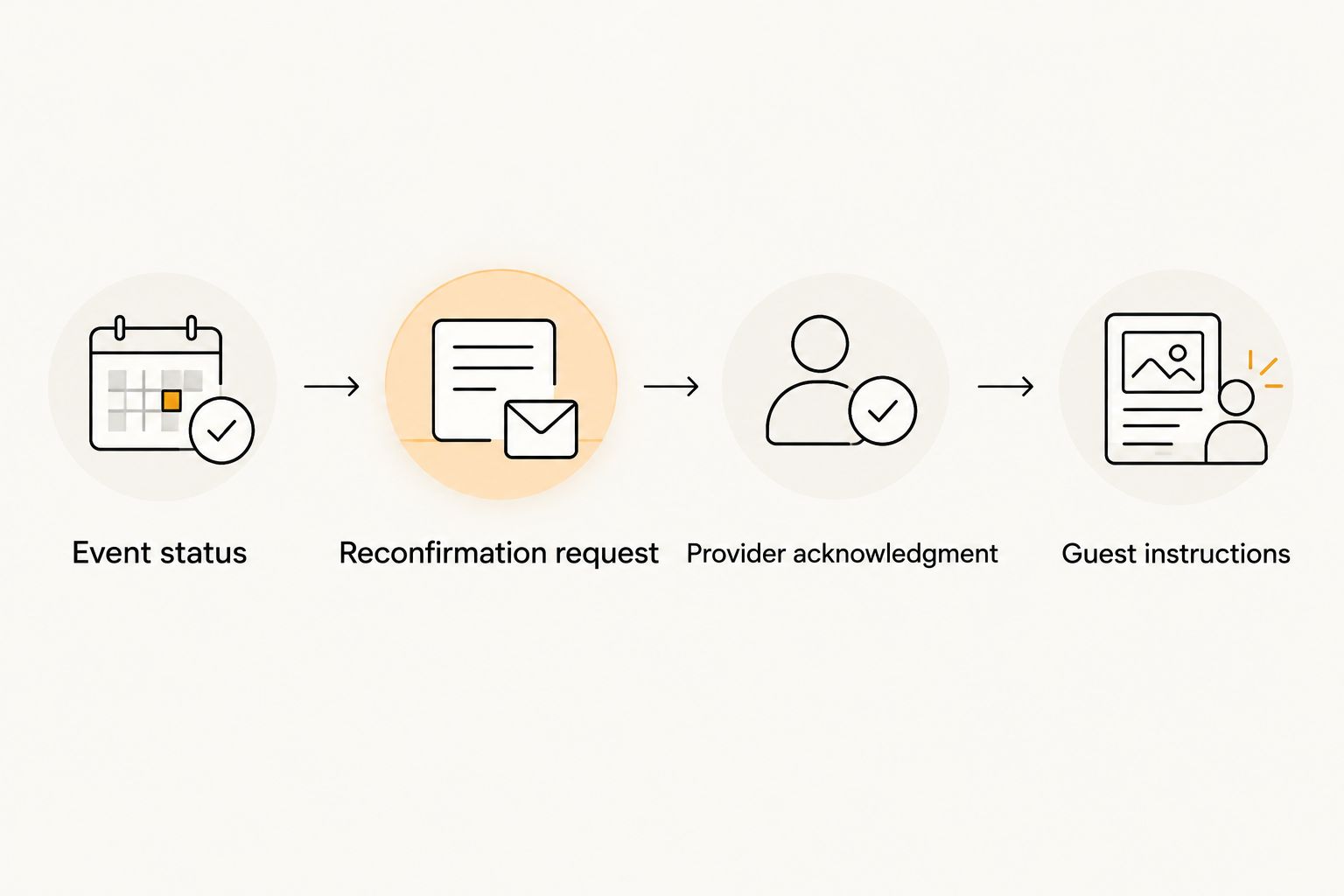
Provider acknowledgment and guest messages
A delivered email or text proves transmission, not acceptance. Build a separate acknowledgment step so your organizer knows whether the provider has reviewed the current return plan.
- Agree what qualifies as Provider acknowledgment. Use an explicit reply or another confirmation method agreed with the provider, rather than interpreting message delivery as approval.
- Record Acknowledged pickup location, Acknowledged pickup time, and Acknowledged destination from the provider's response. Preserve any instructions concerning boarding or group assembly.
- Compare the acknowledgment with the latest request. If the provider responds to an earlier version, clarify the discrepancy before notifying passengers.
- Set Request status to Acknowledged only after that review. Keep unresolved requests visibly pending and assign follow-up to the primary organizer.
- Send Guest instructions containing the confirmed meeting point, agreed pickup details, organizer contact, and luggage instructions. Share only information passengers need; keep private traveler details out of group messages.
Expected result: Guests receive one current set of instructions supported by provider acknowledgment. The organizer can identify what was accepted and which request it answers.
Luxortrans transportation service, phone support, and reservations operate 24 hours a day. That operating schedule does not guarantee vehicle availability, a particular pickup time, or an arrival time. Keep your follow-up process tied to the arrangements agreed for the booking.
Exception routing and verification
Before relying on the workflow at a live event, test the logic without creating a transportation request. Use a clearly marked planning copy and keep test messages away from the provider's operational channel unless testing has been arranged.
- Assign Exception owner to the primary organizer and identify the backup. Give both access to the current itinerary and agreed provider contact method.
- Define Follow-up point with the provider. Use the booking's agreed procedure rather than inventing a universal response interval.
- Test a complete record, an incomplete record, and a repeated status update. Confirm that missing information stops the request and repeated updates do not duplicate it.
- Test a changed destination and a canceled event. Neither should produce a guest confirmation based on the original arrangement.
- Confirm that Guest instructions remain blocked until the organizer records and checks Provider acknowledgment.
Expected result: The workflow identifies missing details and unresolved changes before passengers act on them.
Keep the latest acknowledged itinerary accessible to the backup organizer during your 2026 event. A workflow is not dependable if its only usable record sits in one person's private inbox.
Reconfirm whenever the event schedule changes
A schedule-change workflow is useful when the agenda moves before guests are ready to leave. It requests review of a revised plan rather than waiting until the event finishes.
Use Schedule revised as a separate event status. Send the provider the original arrangement, proposed change, reason for the change, and affected passenger group. Keep the original acknowledged plan visible until the provider accepts a replacement; do not silently overwrite it.
| Workflow | Best for | Advantage | Limitation |
|---|---|---|---|
| Readiness-triggered reconfirmation | Groups with an uncertain event finish | Reports that passengers are ready | Does not reserve a new pickup arrangement by itself |
| Schedule-change reconfirmation | Planners revising an agenda before departure | Gives the provider earlier notice of a proposed change | Requires review whenever the plan changes again |
Use readiness-triggered reconfirmation for actual departure readiness; use schedule-change reconfirmation for proposed itinerary changes. Both workflows need provider acknowledgment before revised passenger instructions.
For airport-bound guests, do not make an extended event the controlling deadline. Review the proposed change against the flight departure requirements and obtain provider confirmation. If the plan no longer works, escalate the decision to the responsible organizer instead of allowing automation to approve it.
Troubleshooting
Guests receive a confirmation before the provider replies
Separate Request status from Provider acknowledgment. Remove any rule that sends confirmed pickup instructions merely because a request was transmitted. Route the request receipt to the organizer, not to passengers as a confirmed arrangement.
The same request sends repeatedly
Check whether every record edit activates the automation. Restrict the trigger to the intended status change and check the current Request status before sending. Reopen the request deliberately when a material change needs another review.
The event runs late, but guests have a flight
Keep Flight departure deadline independent of Event status. Ask the provider to review the revised itinerary and have the organizer decide when airport-bound travelers must leave. Do not automatically shift the airport movement to match the later event finish.
The acknowledgment contains an old boarding point
Compare the reply with the current request and booking reference. Ask the provider to acknowledge the revised boarding point explicitly, then replace passenger instructions. Never combine the time from one version with the location from another.
The primary organizer cannot respond
Transfer follow-up to the backup organizer using the shared record. The backup needs the latest acknowledged plan, outstanding request, and provider contact—not a summary reconstructed from guest messages.
Customize your workflow
Extend the record to cover airport, hotel, corporate, wedding, and private-event movements without treating them as interchangeable trips. Each movement needs its own destination, passenger group, boarding instructions, and acknowledgment.
For larger events, use the group transportation planning guide to organize the wider itinerary. Keep confidential VIP details separate from guest-wide departure notices while preserving the information the transportation provider needs.
Luxortrans offers discreet VIP service, higher-end vehicles, and local Oahu knowledge alongside group transportation. These are reasons to discuss the full itinerary with one provider; they do not remove the need to confirm each movement's requirements.
Before your 2026 event, ask the provider to review the communication channel, boarding point, luggage plan, and escalation owner together. That conversation establishes the operating agreement your automation follows.
FAQ
Can I automatically confirm return airport pickup after an Oahu event?
You can automate a reconfirmation request and release guest instructions after provider acknowledgment. An event-end trigger alone does not confirm a vehicle or a revised pickup arrangement.
Does Luxortrans have a native event-management integration?
This guide describes a planner-controlled workflow, not a native Luxortrans integration. Agree the communication method with the provider before connecting your planning system to any outgoing messages.
Should the trigger use the event end time or guest readiness?
Use organizer-confirmed guest readiness for the departure request. A calendar end time does not establish that travelers have collected their belongings or reached the boarding point.
What happens if the event finishes later than planned?
Request provider review of the revised itinerary before changing passenger instructions. For airport transfers, keep flight departure requirements separate from the event schedule.
Can the same workflow handle hotel and airport returns?
Yes, with separate return records for distinct destination groups. Airport-bound travelers need flight-related planning that hotel-bound guests do not share.
Does round-the-clock phone support guarantee a pickup?
No, round-the-clock support does not guarantee vehicle availability or a particular pickup or arrival time. Obtain acknowledgment of the actual transportation arrangement.
Can I follow this process without automation software?
Yes, an organizer can update the shared record, send the reconfirmation request, and record the provider's reply manually. Keep the same approval gate before sending confirmed guest instructions.
One last thing
The safest thing to automate is the handoff, not the promise. A request reaching the provider and a confirmed instruction reaching the guest are different events. Keep that distinction visible, and your return-transfer workflow remains useful even when the evening changes.