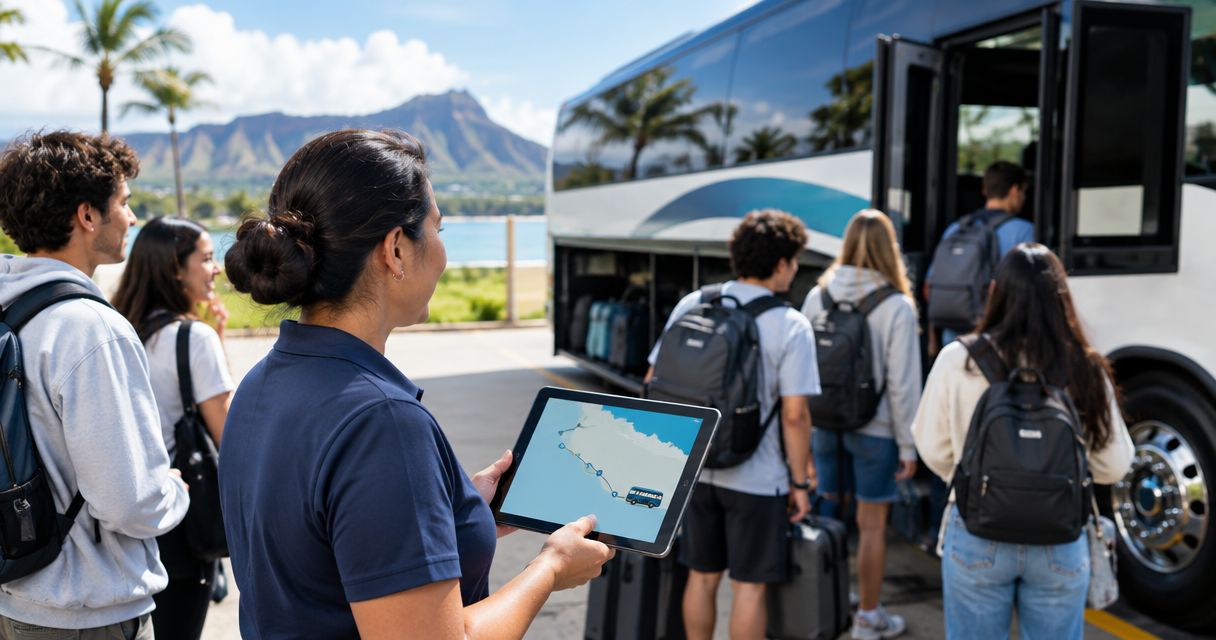

Event planners’ group transportation planning is the coordination of guest arrivals, vehicle assignments, venue transfers, and return journeys to welcome guests with genuine island hospitality and keep an event’s movements organized. For Oahu events in 2026, your plan must connect airport coordination, hotel departures, venue access, and discreet VIP arrangements without treating every guest as part of the same itinerary.
- Group transportation planning for event planners starts with a shared passenger manifest, confirmed venue access, and assigned dispatch responsibilities.
- Luxortrans group transportation suits Oahu planners coordinating premium airport transfers, hotel movements, and private-event travel.
- Match vehicles to passengers, luggage, and boarding requirements—not guest count alone.
- Confirm each movement in writing; round-the-clock service does not guarantee a particular vehicle or pickup time.
Why group transportation matters for event planners
Your guests experience transportation before they experience the event. A clear airport meeting instruction, a suitable vehicle, and a named contact help establish the attentive welcome you want to deliver. A vague pickup instruction leaves guests and planners resolving basic questions during a live arrival.
Oahu event planning also brings several separate journeys into one program. Airport arrivals follow flight schedules; hotel departures follow the event agenda; wedding-party and executive movements can require separate arrangements. Build those journeys as connected assignments rather than a single booking labeled group transportation.
Luxortrans group transportation is for Oahu event planners coordinating premium airport, hotel, and private-event travel. Luxortrans combines higher-end vehicles, discreet VIP service, and local Oahu knowledge with transportation service, phone support, and reservations operating 24 hours a day. Confirm the arrangements for your specific event rather than treating operating hours as a pickup or vehicle commitment.
For your 2026 event plan, define success operationally: guests know where to go, the provider knows whom to move, and your team knows who authorizes changes.
How to plan group transportation for an Oahu event
Define the movements before choosing vehicles
Start manually with a shared spreadsheet and the event agenda. Give every distinct journey its own row, including the final return. A hotel-to-reception transfer and a reception-to-hotel transfer need separate instructions even when the passengers are identical.
For each movement, identify the departure point, destination, passenger group, required arrival, and person responsible. Keep a fixed program requirement separate from a preferred departure time. That distinction lets the transportation provider assess the route without mistaking a draft schedule for a confirmed commitment.
Write the movement brief before requesting a vehicle. A request for group transportation alone does not explain luggage, separate hotels, or a private departure for the host. Share the brief with your venue contact as well; the transportation plan must work at the property entrance, not just on your spreadsheet.
Close this step with a brief covering:
- Event purpose: Identify the meeting, celebration, reception, or private gathering.
- Movement list: Separate airport, hotel, venue, and return journeys.
- Schedule constraints: Mark fixed program commitments and flexible departures.
- Decision owner: Name the person who can approve itinerary changes.
Build a usable passenger manifest
Create the manifest yourself before selecting a platform or provider. A shared spreadsheet works when the planner controls edits and clearly labels the current version. Organize passengers by movement rather than relying only on an alphabetical guest list.
Collect information that changes the transportation assignment. Flight details matter for airport transfers; luggage matters for vehicle suitability; boarding requirements matter for loading arrangements. Ask guests about assistance needs privately and share operational details only with people responsible for delivering the service.
Use the following categories to structure your 2026 manifest. They keep the information relevant without turning a dispatch document into a collection of unnecessary personal details.
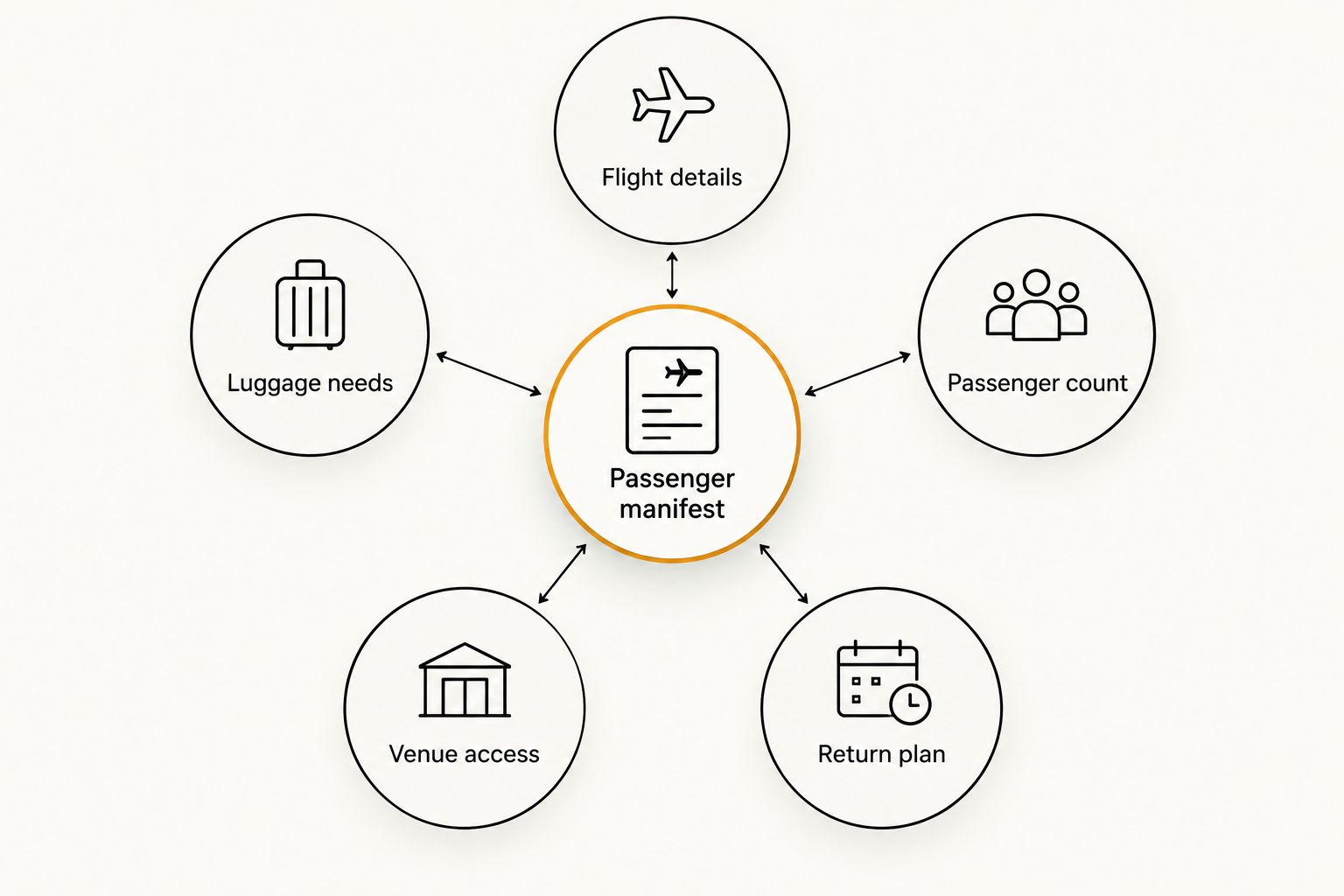
Keep a restricted operational copy for dispatch and a simpler guest-facing itinerary. Those documents serve different audiences and should not carry identical detail.
- Flight details: Record the flight identifier, arrival date, and assigned contact.
- Passenger count: Assign each traveler to a specific movement.
- Luggage needs: Note suitcases, event materials, and oversized belongings.
- Venue access: Record boarding requirements and property instructions.
- Return plan: Identify each guest’s intended departure movement.
Match the vehicle arrangement to the assignment
Use the manifest to compare vehicle arrangements manually. Ask each provider to confirm suitability for the actual passengers and belongings rather than selecting by a vehicle photograph or a seating description alone. Passenger seating and practical luggage space are different questions.
A coach arrangement groups passengers around a common departure, while separate car or limousine movements accommodate distinct itineraries. Neither approach replaces the need to confirm boarding requirements and venue access. Your Oahu ground transportation options by group size can help frame the initial discussion, but the final assignment needs the full brief.
Luxortrans provides limousines, taxis, and coaches for airport transfers, hotel transfers, and private events. Giving one provider the connected itinerary reduces the number of separate handoffs your team must organize; you still need written confirmation of vehicle assignments and responsibilities.
- Confirm passenger and luggage requirements together.
- Describe any boarding assistance or equipment requirements explicitly.
- Separate VIP movements when privacy or itinerary differences require it.
- Ask the provider to confirm suitability for each pickup and destination.
Work backward from the venue requirement
Start with the point at which guests must be ready for the program, not merely the point at which a vehicle reaches the property. Guests still need to unload, enter the venue, and reach their seats or check-in location.
Build the draft schedule manually with your venue and transportation contacts. Ask the venue where vehicles can stop, whether staging is permitted, and who controls access. Ask the provider to review the proposed movement against the route and operating conditions. Do not insert a universal travel-time allowance and assume it fits every Oahu journey.
For a 2026 program, keep the transportation schedule beside the event agenda during revisions. Moving a ceremony, speaker session, or dinner changes the connected departures. A venue update that never reaches dispatch leaves the transportation plan attached to an outdated event.
- Confirm the required guest-ready time with the event lead.
- Obtain the venue’s loading, unloading, and staging instructions.
- Have the provider review departure times and route assumptions.
- Recheck connected movements whenever the event agenda changes.
Assign airport, hotel, and VIP handoffs
Write the handoff instructions in plain language first. An arriving guest needs a meeting instruction and a contact, while a hotel coordinator needs the departure group and escalation procedure. Sending the full operations spreadsheet to everyone does not make those instructions clearer.
Dependable airport coordination requires more than collecting a flight number. Confirm who monitors changes, who communicates revised instructions, and how guests report that they are ready. Keep the meeting arrangement specific to the confirmed booking rather than assuming a particular airport greeting service is included.
For VIP travel, share identifying details only with the people who need them. Luxortrans emphasizes discreet VIP service; explain your privacy requirements during planning so the written arrangements reflect the assignment. Professional chauffeurs and local Oahu knowledge support the guest experience, but your team must still define the handoff.
- Give guests a concise pickup location and contact instruction.
- Assign responsibility for communicating flight or itinerary changes.
- Identify the hotel or venue coordinator for each departure.
- Restrict VIP names and itinerary details to relevant personnel.
Confirm responsibilities before releasing guest instructions
Use a written confirmation checklist to review the provider’s proposal against your brief. Compare each movement rather than checking only that the event date is correct. Look for omitted returns, unclear stops, and arrangements described differently across documents.
A single provider can simplify coordination across airport, hotel, corporate, wedding, and private-event travel. The limitation is that a broad service description does not define your booking. Luxortrans operates transportation service, phone support, and reservations 24 hours a day; obtain event-specific confirmation without interpreting those operating hours as guaranteed arrangements.
For your 2026 event file, keep the accepted itinerary, current manifest, and provider confirmation together. Clearly distinguish a request under discussion from an approved movement. Release guest instructions only after the responsible parties have agreed on the details those instructions contain.
- Confirm every pickup, destination, stop, and return movement.
- Record the agreed vehicle arrangement and boarding requirements.
- Clarify change procedures, waiting arrangements, and cancellation terms.
- Name the planner and provider contacts responsible for decisions.
Reconcile changes through a single decision path
Maintain a simple change log in the shared planning file. Record what changed, who approved it, and who received the update. Do not rely on a collection of private messages to establish the current plan.
Assign a dispatch lead for your team and identify the provider contact for operational updates. Guest-facing staff should know where to send a request without independently changing an assignment. This preserves a clear decision path when an executive leaves early or a reception runs beyond the planned departure.
Prepare responses to likely disruptions before the event. A delayed flight, changed headcount, or revised venue entrance requires a decision, not just an alert. Confirm the response with the provider and relevant property contact rather than promising guests an unapproved replacement arrangement.
- Mark the current itinerary version and withdraw superseded copies.
- Route operational changes through the assigned decision-maker.
- Prepare procedures for flight changes, missed departures, and changed headcounts.
- Reconcile the final return movements before closing event operations.
Compare transportation arrangements for your event
Choose the arrangement that matches the movement, not the most impressive vehicle description. Use this comparison to frame provider discussions; it does not establish a particular vehicle’s suitability or the terms of a booking.
| Option | Best for | Main advantage | Key limitation |
|---|---|---|---|
| Coordinated coach transportation | Guests sharing a departure and destination | Keeps a common group movement under one plan | Different guest schedules require separate arrangements |
| Separate car or limousine transfers | VIPs, speakers, or guests with distinct itineraries | Allows individualized routing and departure instructions | Creates more assignments for dispatch to track |
| A mixed vehicle plan | Events combining main-group travel and private movements | Matches different assignments to different vehicle arrangements | Requires clear manifests and responsibility for each movement |
| Guest-arranged transportation | Optional journeys outside the hosted program | Gives guests control over their own travel decisions | Removes those journeys from the planner’s coordinated dispatch plan |
A mixed plan is useful when your main group shares a program but hosts or speakers follow separate schedules. Its advantage depends on clear documentation: without distinct assignments, the extra flexibility becomes extra coordination work.
Guest-arranged transportation has a place outside the hosted itinerary. For essential event movements, decide explicitly whether the organizer or the guest owns the journey. Ambiguity creates a service expectation your operations team has not planned to meet.
Request a quote for seamless Oahu transportation
Share your airport, hotel, venue, passenger, and luggage requirements for an event-specific discussion.
Common mistakes event planners make
Booking against the invitation count
An invitation total is not a movement manifest. Guests arrive on different flights, stay at different properties, and leave at different times. Confirm the passengers assigned to each journey before approving the vehicle arrangement, then update the assignment when attendance changes.
Treating the hotel name as a pickup instruction
A property name does not identify the agreed boarding point or explain vehicle access. Obtain instructions from the property and confirm them with the provider. Give guests a clear meeting instruction without assuming every entrance supports the same loading arrangement.
Forgetting the final return
The outgoing transfer is only part of the hosted journey. Confirm whether guests return together, leave in separate groups, or make their own arrangements. Include the late departure for hosts, organizers, or event staff when it belongs within your transportation scope.
Distributing private details too widely
A guest needs their own travel instructions, not everyone else’s flight details or private itinerary. Separate the guest message from the operational manifest. Limit sensitive information to the coordinators and transportation personnel responsible for that movement.
Confusing support hours with a confirmed booking
Round-the-clock support describes when a company operates; it does not confirm a particular assignment. Keep requested changes separate from accepted changes. Update guests only after the provider has confirmed the arrangement that affects their journey.
FAQ
How do I start group transportation planning for an Oahu event?
Start with a movement list covering airport arrivals, hotel departures, venue transfers, and returns. Assign passengers and an operational contact to each journey before choosing vehicles.
Should I book a coach or separate cars for my event guests?
Use a coach arrangement for guests sharing a departure and destination, and separate cars for distinct itineraries. Confirm luggage, boarding requirements, and venue access before approving either arrangement.
Can one provider handle airport, hotel, and wedding transportation?
Luxortrans provides airport transfers, hotel transfers, and private-event transportation. Ask for a connected itinerary that confirms each assignment, vehicle arrangement, and responsible contact.
Does 24-hour transportation service guarantee my requested pickup?
No, round-the-clock operation does not confirm a specific pickup or vehicle assignment. Luxortrans transportation service, phone support, and reservations operate 24 hours a day; obtain written confirmation for your event.
What information should I send when requesting group transportation?
Send the movement list, passenger counts, flight details, luggage requirements, venue instructions, and return plans. Identify fixed program commitments and any private or separate guest itineraries.
How should I handle a delayed flight on event day?
Follow the flight-change procedure agreed with your transportation provider. Send the revised flight information to the assigned contact and obtain confirmation before distributing replacement pickup instructions.
How do I protect VIP privacy in a transportation plan?
Separate guest-facing instructions from the restricted operational manifest. Share names, contacts, and private itinerary details only with the people responsible for the relevant movement.
One last thing
Separate vehicle arrival from guest readiness. A vehicle reaching the venue does not mean every passenger has unloaded, entered, and reached the program. Ask the venue lead to define the guest-ready point, then build your transportation schedule backward from that requirement. This gives the transportation provider and your event team the same destination in operational terms—not just the same street address.