

Instead of manually rebuilding hotel pickup lists whenever a convention agenda changes, create one approved agenda-to-dispatch workflow that connects each session to a confirmed passenger movement. For convention shuttle dispatch Honolulu planners can use in 2026, start with genuine island hospitality: clear meeting instructions, discreet passenger handling, and an accountable contact from arrival to destination.
- For convention shuttle dispatch Honolulu planners need, turn agenda changes into approved transport instructions, not automatic vehicle movements.
- Luxortrans suits Oahu convention planners seeking premium group transportation and discreet VIP service from one provider.
- Separate session start times, passenger report times, vehicle departure times, and provider-confirmed assignments.
- Release a dated dispatch sheet, require acknowledgment, and withdraw superseded instructions before each movement.
Why this matters
A convention agenda describes what attendees will do. A dispatch sheet tells transportation staff who must move, where passengers should assemble, and which instructions are approved. Copying a session time into a pickup column leaves those decisions unresolved.
Luxortrans is suited to Oahu convention planners seeking premium group transportation and discreet VIP service from one provider. Its Oahu transportation scope includes airport transfers, hotel transfers, and private events, allowing you to discuss connected movements with Luxortrans rather than treating every leg as a separate planning exercise.
For your 2026 convention, keep the workflow independent of any particular scheduling application. A shared spreadsheet and controlled distribution process are enough to organize the information; vehicle assignments and operating arrangements still require provider confirmation.
Before you start
- Gather the source material and access. Obtain the current agenda, hotel assignments, registration counts, venue loading instructions, and permission to maintain a shared planning file. Collect accommodation or mobility requirements privately, with access limited to people coordinating the service.
- Name the decision-makers. Identify an event transport lead, a provider contact, and a venue or hotel contact for each loading location. Record 2 reachable contacts for each movement: the event-side lead and the provider-side contact.
- Resolve the hidden constraint first. Confirm where vehicles can actually load and stage. A hotel address or venue entrance is not sufficient pickup authorization; ask the property or venue to confirm the designated location before publishing passenger instructions.
Use the field names below as labels you create in your own planning file. They are not claims about a provider portal, booking system, or built-in integration.
Agenda source and movement register
Turn sessions into transport requirements
- Create an Agenda source sheet. Record Session ID, Session title, Session date, Session start, Session finish, Venue, and Agenda owner. For a 2026 event, include the year in every date and state that operational times are Honolulu local time.
- Create a separate Movement register. Use Movement ID, Linked session, Origin, Destination, Passenger group, Expected passengers, Luggage needs, and Access requirements. Maintain 1 row per transport leg, not one row per conference session.
- Connect each movement to its purpose. Morning hotel departures, speaker transfers, evening functions, and return journeys need separate records when their passengers or instructions differ.
- Mark unresolved information in an Open questions field. Assign each question an owner rather than filling the gap with an assumed departure time or vehicle type.
Expected result: You can trace every proposed shuttle movement to an agenda item or an explicit event requirement. You can also identify sessions that need no transport instead of creating unnecessary trips.
Keep passenger names out of the general agenda sheet. Use a restricted manifest reference where individual identification is necessary, especially for VIP movements and travelers requesting assistance.
For connected corporate schedules, the meeting itinerary to executive car dispatch workflow addresses the adjacent task of translating individual meeting commitments into separate car movements.
Timing plan and service pattern
Separate the times that control a departure
- Add Required arrival, Passenger report, Planned departure, and Provider-confirmed timing. Keep these distinct from Session start. Ask the program owner when attendees must actually be inside the venue, not merely when the published session begins.
- Ask the transportation provider to review the route, loading arrangement, passenger needs, and proposed schedule. Use that discussion to establish operating times; do not apply a generic driving estimate to every hotel and destination.
- Select a Service pattern for each movement. Use a scheduled departure for a defined group or discuss a continuous loop when attendees need repeated travel between locations.
- Record Return arrangement explicitly. State whether passengers have an assigned return, a published shuttle window, or a separately coordinated movement. Do not let the outbound trip imply a return booking.
Expected result: Each movement has a passenger-facing instruction and a provider-reviewed operating plan. Neither depends on interpreting the convention agenda at the curb.
Choose the service pattern by passenger behavior
| Service pattern | Best for | Advantage | Limitation | Planning requirement |
|---|---|---|---|---|
| Scheduled departure | Registered groups traveling to a defined session | Gives attendees a specific assembly instruction | Late arrivals require a separate decision | Confirm the manifest and late-passenger procedure |
| Continuous loop | Attendees moving between recurring event locations | Supports repeated journeys without assigning everyone one departure | Does not give each traveler a reserved departure time | Agree stops, operating window, and dispatch oversight |
| Dedicated VIP movement | Speakers or guests with individual commitments | Keeps routing and passenger details separate from general shuttles | Adds a distinct assignment and coordination task | Confirm the authorized contact and private instructions |
For Luxortrans convention transportation planning, the value is discussing group movements and discreet VIP requirements together. The limitation is equally important: shared coordination does not make those movements interchangeable, and each still needs confirmed operating details.
Dispatch sheet and approval controls
Build the instruction staff will actually use
- Create a Daily dispatch sheet for each operating date. Include Movement ID, Current revision, Release status, Pickup location, Passenger report, Planned departure, Destination, Assigned vehicle, Provider contact, and Event contact.
- Copy only approved movement details into the daily sheet. Leave Assigned vehicle unresolved until the provider confirms the assignment; a requested vehicle category is not an operating assignment.
- Use explicit planning statuses: Draft, Awaiting confirmation, Released, Superseded, and Completed. Define Released as instructions approved by the event lead and acknowledged by the provider contact.
- Add a Change log with Changed field, Previous instruction, New instruction, Approved by, and Acknowledged by. Retain the prior version for reference, but remove it from active distribution.
Expected result: Staff can identify the current operating instructions without checking several email threads. Every released change has an owner and an acknowledgment record.
The 2026 dispatch file should distinguish the requested plan from the confirmed plan at a glance. Keep the sequence visible: Agenda source, Movement register, Daily dispatch, and Change log.
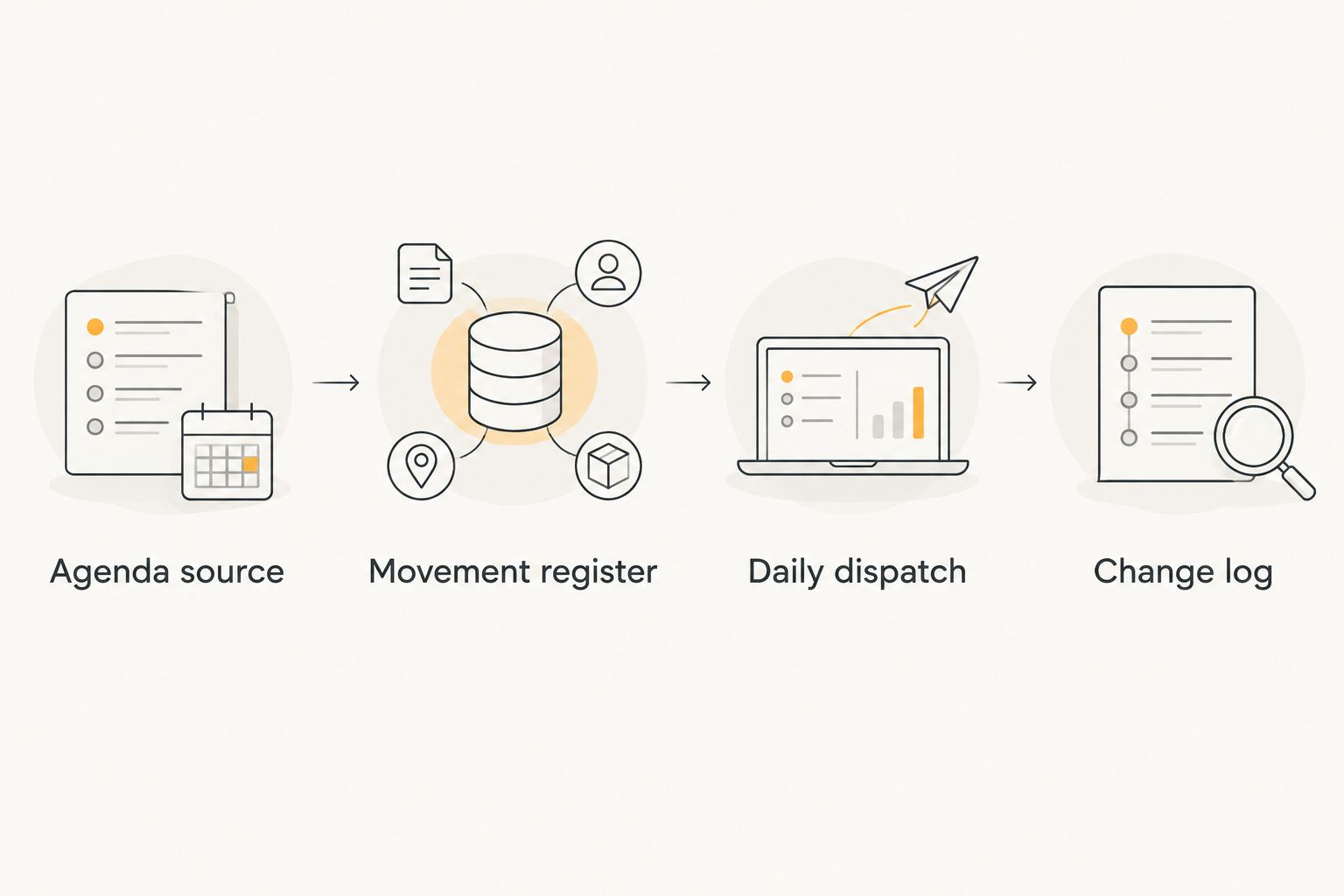
Do not describe this file as a live connection to the transportation provider unless you have agreed that arrangement. A shared document organizes your instructions; it does not dispatch a vehicle by itself.
Daily release and passenger communication
Close the loop before passengers assemble
- Review the operating date with the provider contact. Check loading locations, passenger counts, approved assignments, special requirements, and unresolved changes. Record the agreed release deadline rather than imposing an unsupported standard interval.
- Distribute the released dispatch sheet to the people responsible for operations. Give passengers a separate, shorter message containing their meeting location, report time, destination, and help contact.
- Require acknowledgment from the provider contact and event-side lead. If either party has not acknowledged a revision, keep the change pending and use the agreed escalation channel.
- Record exceptions during service. Note missed passengers, changed locations, canceled movements, and completed trips against the relevant Movement ID. Reconcile those records before releasing the next operating day's sheet.
Expected result: Passengers receive simple instructions while coordinators retain the detail needed to manage the movement. A changed spreadsheet cell is no longer mistaken for a confirmed instruction.
Luxortrans transportation service, phone support, and reservations operate 24 hours a day. That supports communication across travel schedules; it does not guarantee a vehicle assignment, pickup time, or arrival time.
For the 2026 event brief, ask the provider how urgent changes should be communicated and who can authorize them. Record that answer in the dispatch file rather than assuming a shared-file notification will reach the person managing the movement.
When the convention agenda changes
A revised agenda should trigger a review, not an automatic departure change. Some edits affect transportation; others only change the wording of a session title.
- Match the revised agenda item to Linked session in the movement register. Identify every connected outbound, return, speaker, or staff movement.
- Compare the changed fields. A room-name correction needs different handling from a venue relocation, an earlier start, or an increased passenger count.
- Ask the event owner to approve the transport requirement, then ask the provider to confirm the revised operating arrangement. Preserve the existing released instructions until a replacement is agreed.
- Update Current revision, record the acknowledgment, and distribute the replacement. Tell recipients exactly which instruction has changed and that the previous version is superseded.
Use the same approval path for cancellations. Removing a session from the agenda does not establish that every related passenger movement should disappear; attendees might still need a hotel return or onward transfer.
For a continuous loop, revise the stop list and operating window instead of editing individual passenger departures. Confirm how staff will communicate a stop closure or a change in boarding location before publishing the revised instructions.
Troubleshooting
Passengers arrive at different hotel entrances
Replace the property name alone with a venue-confirmed meeting description. Give passengers the same location wording used by the event-side boarding lead, and update both the passenger message and dispatch sheet together.
A coordinator is using an old dispatch sheet
Mark the old version Superseded, withdraw it from active circulation, and resend the current release with the changed instruction highlighted. Require acknowledgment from the affected contacts rather than assuming the replacement email resolved the conflict.
Registered attendance differs from the boarding group
Reconcile the transport list separately from the convention registration total. Ask group leads who will actually ride, whether guests are included, and whether luggage or assistance requirements have changed; send the revised requirement to the provider for review.
A delayed session affects the return journey
Have the program owner confirm the revised release time and ask the provider to review the return movement. Do not announce a later departure until the operating change is confirmed, especially when the same assignment serves another movement.
A VIP request appears in the general passenger message
Withdraw the message and send a corrected version that contains only shared boarding information. Move individual routing, personal contact details, and special instructions into the restricted coordination record.
Customize your workflow
Extend the same movement register to airport arrivals, hotel transfers, corporate meetings, weddings, and private events when they form part of the convention program. Keep each movement separately identifiable even when one provider coordinates the wider itinerary.
For airport-linked arrivals, record flight information and the onward destination in a restricted working record. Keep those movements separate from convention shuttle departures so a flight change prompts review of the affected transfer rather than a blanket change to the event schedule.
Luxortrans Oahu ground transportation combines premium vehicles, professional chauffeurs, local island knowledge, and discreet VIP service for individuals and groups. Give that coordination a clear brief: approved locations, realistic passenger requirements, and a named decision-maker.
For your 2026 closeout, retain the final released plan and unresolved lessons, not unnecessary copies of passenger information. Follow your organization's retention rules and restrict access to records that still serve an operational purpose.
FAQ
How do I turn a Honolulu convention agenda into a shuttle dispatch plan?
Create a movement register that links each required trip to an agenda item, then release a daily dispatch sheet after event-side approval and provider confirmation. Keep session times, passenger report times, departures, and return arrangements in separate fields.
Can a spreadsheet automatically dispatch convention shuttles?
A spreadsheet does not dispatch vehicles by itself. Use it to organize requirements and revisions, then obtain acknowledgment through the communication process agreed with your transportation provider.
Should I choose scheduled departures or a continuous shuttle loop?
Choose scheduled departures for defined groups with shared arrival requirements, and discuss a continuous loop for repeated travel between event locations. Each pattern needs its own confirmed stops, operating instructions, and passenger communication.
What should I do when a convention session ends late?
Confirm the revised passenger release time with the program owner and ask the transportation provider to review the return arrangement. Publish a replacement instruction only after the operating change is confirmed.
Does Luxortrans provide transportation support around the clock?
Luxortrans transportation service, phone support, and reservations operate 24 hours a day. That operating schedule is not a guarantee of vehicle availability, pickup timing, or arrival timing.
What information belongs in a convention shuttle quote request?
Include operating dates, pickup and destination locations, proposed timing, expected passenger groups, luggage needs, and assistance requirements. Distinguish confirmed requirements from unresolved agenda items so the provider can review the actual scope.
How should I handle VIP passengers on a convention shuttle plan?
Keep VIP routing and individual contact details in a restricted record separate from general passenger instructions. Link the movement to the main dispatch plan without distributing private information to the full attendee group.
One last thing
The most useful dispatch field is often acknowledgment, not departure time. A perfectly formatted schedule still fails as an instruction if the person responsible for acting on it has not received and accepted the revision.
Before releasing your first operating day, ask each movement owner to identify the current instruction and the person authorized to change it. Resolve any disagreement before attendees receive their boarding message.