

Destination management team transportation is the coordination of guest movements across airports, hotels, venues, and activities with the aim of keeping an Oahu program organized and its guests cared for. Genuine island hospitality begins with clear arrival instructions, discreet handling of guest details, and a transportation plan that connects every part of the visit.
- Transportation for destination management teams requires one coordinated plan for airport transfers, hotel departures, event movements, and guest changes.
- Luxortrans suits Oahu teams seeking premium group transportation, discreet VIP service, and dependable airport coordination.
- Assign an owner to every movement, confirm luggage requirements, and separate flight arrivals from vehicle departure instructions.
- Transportation service, phone support, and reservations operate 24 hours a day; specific arrangements still require confirmation.
Why transportation matters for destination management teams
Your team manages an entire guest program, not an isolated ride. An airport arrival feeds a hotel check-in; a hotel departure feeds an event; an evening return closes the guest experience. Each movement needs its own instructions without losing the connection to the wider itinerary.
Build your 2026 transportation plan around guest handoffs, not just vehicle bookings. A reservation does not tell a hotel representative which guests are still collecting luggage or tell an event host who authorizes a changed departure.
Start with the same movement-by-movement discipline used in group transportation planning for event planners. Destination management teams also need to connect those event movements with flight changes, hotel assignments, private excursions, and VIP requirements.
The practical constraint is coordination: different people hold different pieces of the itinerary. Your transportation brief should bring those details together while keeping sensitive guest information restricted to the people who need it.
How to plan destination management transportation on Oahu
Define the movements before requesting vehicles
Start with a shared spreadsheet rather than a list of vehicle requests. Give each movement its own row, including airport arrivals, hotel transfers, venue departures, activity transfers, and final airport returns. Use 1 master manifest as the working source for your team.
Separate the guest's scheduled activity from the transportation task. A dinner start time, for example, is not a pickup instruction. Record the destination, the required arrival, and the departure arrangement separately so the provider can review the proposed sequence.
For a 2026 program, put the travel date and local time beside every movement. Avoid relying on an email subject line to establish which day an instruction applies to.
- Assign a unique movement reference to each transfer.
- Record the pickup location and destination in separate fields.
- Identify the planner responsible for approving that movement.
- Mark each entry as proposed, confirmed, changed, or completed.
- Keep superseded instructions out of the active manifest.
Collect guest requirements without oversharing
Use a simple intake form or a structured email to collect what affects the transfer. Ask about luggage, mobility requirements, child passengers, and guests who need to travel together. A passenger total alone does not describe the transport requirement.
Keep 2 contact roles distinct: the planner who can approve changes and the guest-facing contact who handles the meeting instructions. One person can fill both roles, but the responsibilities still need to be clear.
Discretion also requires restraint. Do not circulate a full VIP itinerary or personal guest information to every venue representative when that person only needs a departure list.
- Collect passenger names and the relevant movement reference.
- Record luggage separately from passenger totals.
- Ask guests to describe accessibility requirements before booking.
- Confirm any child-restraint requirements with the provider.
- Share sensitive details only with the people handling that transfer.
Brief one provider on the complete program
Prepare the brief yourself before asking a transportation company to coordinate it. Include the movement schedule, passenger requirements, hotel list, event locations, and change-approval contact. This gives the provider a defined plan to review rather than a series of disconnected requests.
Luxortrans provides premium Oahu ground transportation for airport, hotel, corporate, wedding, and private-event travel, including service for individuals and groups. Its airport coordination, higher-end vehicles, discreet VIP service, and local Oahu knowledge fit a destination management brief spanning several parts of a visit.
Luxortrans is suited to Oahu destination management teams seeking premium group transportation and discreet VIP service. The remaining work is program-specific: confirm the proposed vehicle arrangements, guest requirements, meeting procedures, and scope in writing rather than treating a service description as an accepted booking.
- Send the complete movement brief with your request.
- Identify which transfers need private VIP handling.
- Ask the provider to review vehicle and luggage requirements.
- Confirm who coordinates changes during the program.
- Request written confirmation of the agreed arrangements.
Match each movement to its guest experience
Compare transport arrangements by what the movement needs to accomplish. A private executive transfer, a group hotel departure, and an independently traveling guest do not require identical handling. Start with the passenger list and itinerary, then discuss suitable vehicle arrangements.
For a 2026 incentive or corporate program, decide which movements need hosted coordination and which can remain individual. Keep luggage and accessibility requirements visible throughout that decision. A vehicle description alone is not confirmation that a particular assignment meets them.
Use 3 requirement fields for every movement: passengers, luggage, and assistance. Add further details where the actual trip requires them rather than copying assumptions from another group.
- Separate VIP transfers from group movements when discretion requires it.
- Keep traveling parties together unless they approve a split.
- Confirm vehicle suitability against luggage and assistance needs.
- Distinguish individual arrival transfers from scheduled group departures.
- Review each vehicle assignment with the provider before finalizing it.
Connect arrivals, hotels, and venues with clear handoffs
Write each handoff as an instruction that stands alone. The arriving guest needs to know how to receive meeting instructions; the hotel representative needs the next departure details; the venue host needs to know who handles the return movement.
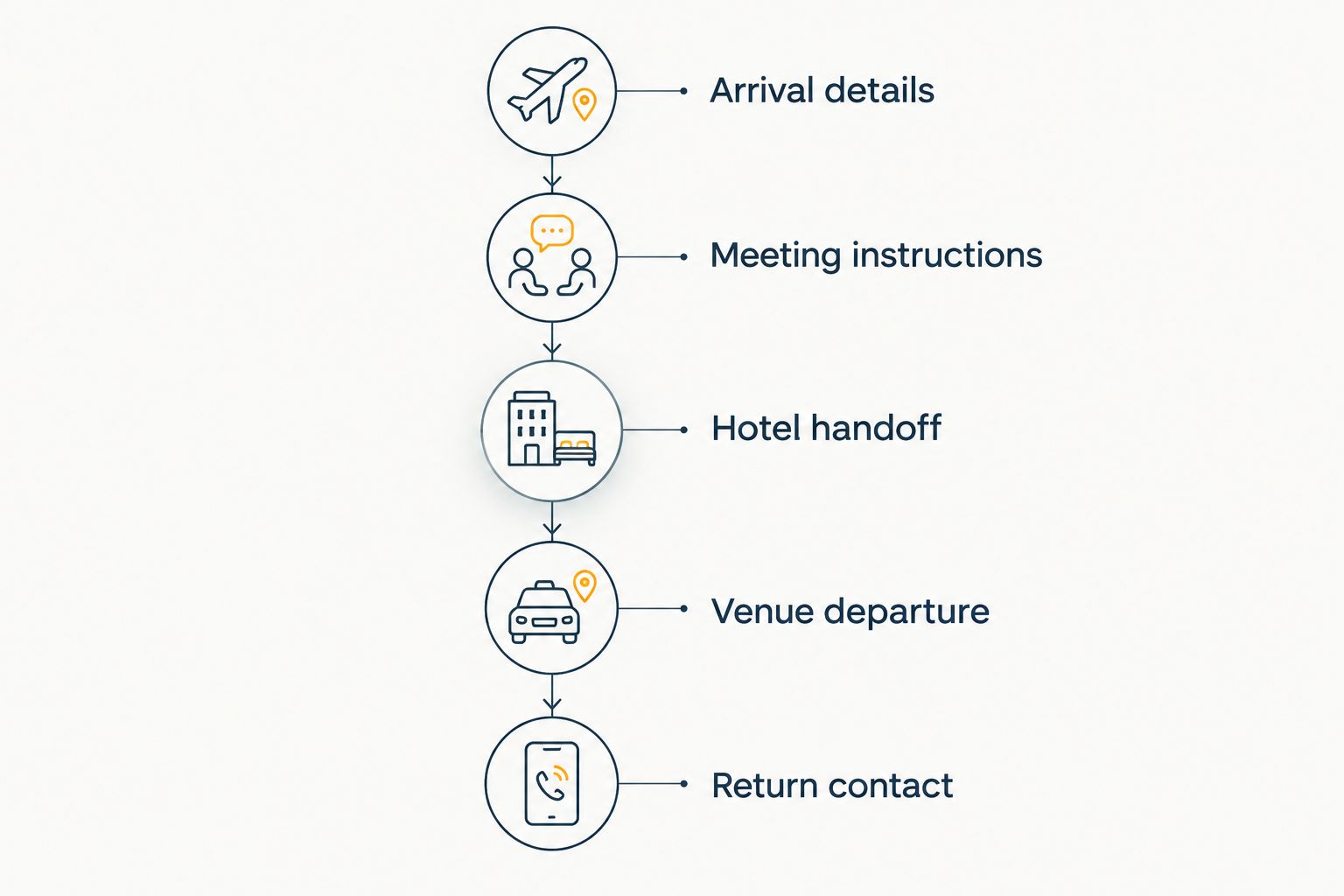
A simple sequence makes the responsibility visible: arrival details, meeting instructions, hotel handoff, venue departure, return contact. Keep those labels consistent across your manifest and guest communications. Do not assume that forwarding the entire itinerary makes the next action obvious.
- Arrival details: connect each guest to the correct flight and transfer.
- Meeting instructions: confirm how guests receive the agreed pickup information.
- Hotel handoff: identify who receives the arriving party.
- Venue departure: name the person responsible for releasing the group.
- Return contact: give guests the appropriate help contact for that movement.
Establish a change and escalation procedure
Begin with a written change log in the same shared file as the manifest. Record what changed, who requested it, who approved it, and whether the provider acknowledged it. A message sent is not the same as an arrangement confirmed.
Luxortrans transportation service, phone support, and reservations operate 24 hours a day. That supports contact across the travel schedule, but it does not guarantee a particular vehicle, pickup time, arrival time, or acceptance of a revised request.
Define the escalation route before guests travel. A delayed flight, a guest who cannot locate the meeting point, and an event that runs past its planned departure need different instructions, even when the same planner handles them.
- Identify who can authorize changes to the transport brief.
- Keep provider acknowledgments with the relevant movement.
- Tell affected guests when their instructions change.
- Record unresolved requests separately from confirmed arrangements.
- Agree on the contact route for urgent assistance.
Reconfirm the program and review completed movements
Review your 2026 manifest against the provider's written confirmation before distributing final guest instructions. Check destinations, dates, passenger names, luggage requirements, and the contact responsible for each departure. Resolve differences before the itinerary reaches hotel and venue teams.
After the program, compare the agreed plan with the movements that took place. Record factual exceptions rather than broad judgments: a revised destination, an additional transfer request, or instructions that guests found unclear. These notes give your next brief something concrete to improve.
Keep guest feedback separate from operational facts. Both matter, but an unclear meeting instruction requires a different correction from a change to the approved itinerary.
- Reconcile the master manifest with the written confirmation.
- Send each guest only the instructions relevant to their movements.
- Confirm that hotel and venue contacts have the current version.
- Log completed movements and approved changes.
- Carry specific improvements into the next program brief.
Compare transportation arrangements for your program
Choose the arrangement by the degree of coordination you need, not by the vehicle category alone. A destination management team should compare responsibility, guest handling, and change procedures alongside the proposed transport.
The options below describe planning approaches rather than a ranking of providers. Confirm the actual scope of any arrangement before adding it to your guest itinerary.
| Option | Best for | Main advantage | Key limitation |
|---|---|---|---|
| Luxortrans coordinated transportation | Oahu programs combining airport, hotel, corporate, wedding, or private-event movements | One provider offering premium individual and group transportation with discreet VIP service and local knowledge | Specific vehicles, meeting procedures, and program arrangements require confirmation |
| Separately booked private transfers | Guest parties whose journeys remain independent | Each transfer can have a distinct brief and contact | Your team must connect the separate confirmations and changes |
| Group coach arrangements | Guests moving together between shared locations | Keeps a group departure organized around one movement | The plan needs to account for guests whose arrival or departure differs |
| Guest-managed taxi travel | Independent travelers handling their own journeys | Guests retain control of their individual travel decisions | Your team does not hold a coordinated group movement plan |
A mixed plan is appropriate when the movements genuinely differ. Keep the same approval process and reporting format across those arrangements so your team can still see the complete program.
Request a quote for seamless Oahu transportation
Share your airport, hotel, event, and group movement requirements for review.
Common mistakes destination management teams make
Treating the manifest as a passenger list
Names alone do not tell a chauffeur or coordinator what needs to happen. A useful manifest connects the guest, movement, destination, requirements, and responsible contact. Build around transfers, then attach passengers to them.
Sending full itineraries instead of pickup instructions
Guests should not have to search a program document to find their next action. Send a short transfer instruction that identifies the relevant date, location, and contact, using the meeting procedure agreed with the provider. Keep the broader itinerary as supporting information.
Assuming premium service settles every requirement
Premium transportation does not establish vehicle capacity, accessibility suitability, luggage arrangements, or a particular meeting procedure. Discuss each requirement explicitly. Treat an unanswered request as unresolved, not as an implied agreement.
Letting several people approve changes
Hotel staff, hosts, travel agents, and guests can all raise valid requests. Without a named approver, their instructions can conflict. Give each movement an approval owner and require the active manifest to reflect the accepted change.
Treating round-the-clock contact as guaranteed fulfillment
A provider's operating hours describe when service, support, and reservations operate; they do not confirm a particular revised arrangement. Obtain acknowledgment of the requested change and communicate the agreed instructions to everyone affected.
FAQ
What is transportation for destination management teams?
Transportation for destination management teams is the coordination of guest travel between airports, hotels, venues, and activities. It combines vehicle arrangements with passenger information, meeting instructions, responsible contacts, and change procedures.
Is one transportation provider better than separate bookings for an Oahu program?
One provider is a suitable choice when your team wants to coordinate several types of Oahu movement through the same transportation relationship. Separate bookings require your team to connect the confirmations, guest instructions, and changes itself.
What should I send when requesting a transportation quote?
Send the travel dates, pickup locations, destinations, passenger totals, luggage requirements, assistance needs, and approval contact. Identify VIP transfers and group movements separately so the proposed arrangements address each requirement.
Does Luxortrans handle both individual guests and groups?
Luxortrans provides premium Oahu ground transportation for individuals and groups. Its services include airport, hotel, corporate, wedding, and private-event travel; confirm the specific arrangements for your program.
Can I contact the transportation provider outside daytime hours?
Luxortrans transportation service, phone support, and reservations operate 24 hours a day. This does not guarantee a specific vehicle, pickup time, arrival time, or acceptance of a requested change.
How should destination management teams handle flight changes?
Update the affected movement and notify the agreed transportation contact. Keep the revised request separate from the confirmed plan until the provider acknowledges the new arrangements, then update guest instructions.
What should I confirm for VIP transportation on Oahu?
Confirm the passenger requirements, discretion needs, vehicle arrangements, meeting procedure, and authorized contact. Share sensitive guest information only with the people who need it to deliver the transfer.
One last thing
Keep the guest's instruction shorter than the planner's instruction. Your operating brief needs destinations, approvals, dependencies, and exceptions; the guest needs a clear next action and a way to get help.
Before distributing your 2026 program, read each guest message without opening the master manifest. If the message depends on information hidden elsewhere, rewrite it. That final check keeps the detailed coordination behind the scenes while leaving guests with a welcoming, understandable arrival-to-destination experience.