

Executive assistants’ ground transportation is the coordination of chauffeured travel with the aim of keeping executive itineraries organized, discreet, and connected from arrival to destination. For your 2026 Oahu travel plans, genuine island hospitality belongs alongside clear airport instructions, professional chauffeurs, and a practical process for handling changes.
- Ground transportation for executive assistants starts with a written itinerary, confirmed pickup instructions, and a named decision-maker.
- Luxortrans suits executive assistants coordinating discreet VIP and group ground transportation on Oahu.
- Confirm passengers, luggage, vehicle requirements, and airport handoff details before approving a booking.
- Keep one traveler-facing summary and one operations document; share sensitive details only where needed.
Why ground transportation matters for executive assistants
An executive itinerary connects flights, hotels, meetings, and events. Ground transportation sits between those commitments, so an unclear pickup instruction becomes more than a transport question: it creates another task for the traveler or assistant to resolve.
Your planning brief must cover both hospitality and operational detail. A welcoming arrival matters, but so do the correct hotel entrance, a reachable contact, and instructions that remain useful when the flight changes.
Luxortrans suits executive assistants coordinating discreet VIP and group ground transportation on Oahu. Luxortrans provides premium vehicles, dependable airport coordination, professional chauffeurs, and local Oahu knowledge for individuals and groups.
For a 2026 booking, distinguish operating hours from a confirmed reservation. Transportation service, phone support, and reservations operate 24 hours a day; that does not guarantee a vehicle, pickup time, or arrival time for your particular itinerary.
How to organize executive ground transportation
Use these 6 steps before sending the final itinerary. You can manage the process with a shared document and calendar; the essential requirement is accurate information and clear responsibility, not a particular planning platform.
Define the itinerary before choosing transportation
Start with a simple trip document. Record each journey separately rather than treating the entire visit as a single airport booking. A hotel transfer, an evening reception, and a return flight each need their own pickup instructions and confirmation.
Work backward from the commitments that cannot move. Ask your transportation provider to assess the route and proposed departure rather than assuming that a map estimate is an agreed pickup plan. Include the destination entrance, not just the property name.
Build the itinerary around the executive’s actual needs. If the traveler needs privacy, an accessible boarding arrangement, or space for work materials, state the requirement without circulating unnecessary personal information.
For each journey, document:
- Arrival details: flight date, flight number, and arrival airport.
- Hotel details: property name, address, and intended pickup entrance.
- Meeting details: destination, required arrival, and onsite contact.
- Return details: departure flight and proposed hotel departure.
- Special requirements: mobility needs, equipment, or handling instructions.
Match the vehicle to passengers and luggage
Write a passenger and luggage list before selecting a vehicle category. A vehicle that sounds suitable by name still needs confirmation against the actual load. Do not infer baggage space or passenger capacity from a photograph.
Separate the traveling party from the working group. An executive traveling with colleagues, an assistant, and presentation materials has a different brief from an individual making a direct hotel transfer. Record any separate arrival times before deciding whether everyone should travel together.
For group movements, compare a shared departure against separate transfers. A shared vehicle keeps the party together, while separate journeys allow different schedules. Neither arrangement removes the need to confirm the vehicle assignment and luggage plan in writing.
Before approving the vehicle, check:
- Total passengers, including accompanying staff.
- Checked bags, carry-ons, and oversized items.
- Mobility and boarding requirements.
- Whether privacy requires separate vehicles.
- Whether arrivals and departures follow the same schedule.
Choose a provider around coordination needs
Begin with a written request that you can send to prospective providers. Use the same itinerary and requirements for each inquiry so you compare responses to the same task. A short confirmation with missing operational details is not equivalent to a fully answered brief.
Luxortrans ground transportation covers airport, hotel, corporate, wedding, and private-event travel on Oahu. That scope suits assistants who want to discuss several journey types with one provider rather than briefing a separate company for every movement.
The limitation is straightforward: a service description is not confirmation of your requested arrangement. Ask which vehicle, journey structure, and communication process apply to the specific booking. Do not assume flight monitoring, waiting arrangements, or extra stops are included without confirmation.
Compare providers on:
- Coverage of every requested journey.
- Vehicle suitability for passengers and luggage.
- Airport coordination and meeting instructions.
- Handling of itinerary changes and additional stops.
- Written terms for waiting, amendments, and cancellations.
Confirm the airport handoff in writing
Build an airport handoff sheet yourself before requesting confirmation. Include the flight, traveler contact, meeting instructions, and the assistant’s contact details. This gives everyone the same information without requiring access to the executive’s full itinerary.
The handoff should explain what the traveler does after landing. Ask where the meeting occurs, how the traveler identifies the chauffeur or vehicle, and whom to contact if the parties cannot find each other. Do not substitute a generic instruction such as “meet outside” for an agreed location.
Your 2026 arrival instructions should also address changes. Establish who communicates a delayed flight, a revised passenger count, or a different destination. Confirm the procedure rather than assuming every change reaches every person automatically.
Record these handoff details:
- The agreed meeting location and identification instructions.
- A reachable traveler contact and backup assistant contact.
- The process for reporting flight changes.
- The procedure if traveler and chauffeur cannot connect.
- The agreed approach to waiting and itinerary amendments.
Assign responsibility for itinerary changes
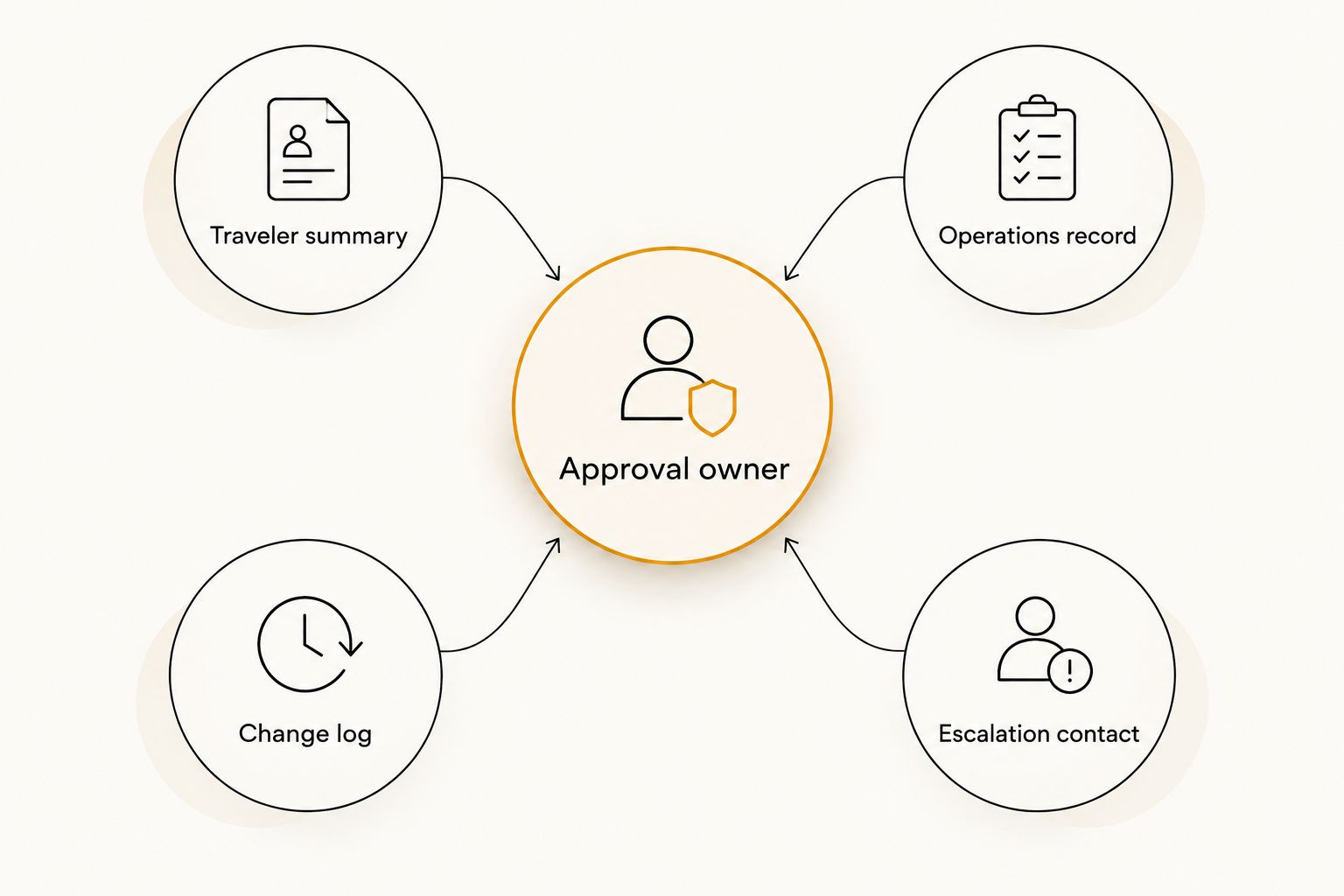
Use one shared operations document and name one person to approve changes. That person can be the executive assistant, a corporate travel coordinator, or an onsite event lead. The role matters more than the job title.
Keep the traveler-facing version separate. The executive needs pickup instructions and useful contacts, not every operational discussion. Your working document should retain the detailed requirements, confirmations, and changes needed to manage the journey.
For 2026 group travel, agree how updates move between the assistant, hotel, event team, and provider. A changed meeting finish does not automatically change the transportation booking. Request acknowledgment of the revised instruction before treating it as accepted.
Set a simple communication structure:
- Approval owner: the person authorized to change the booking.
- Traveler summary: pickup details and essential contacts.
- Operations record: requirements, confirmations, and amendments.
- Change log: the latest accepted instruction for each journey.
- Escalation contact: the person who handles unresolved questions.
Close the booking with a final confirmation
Review the provider’s written confirmation against your original brief. Check every journey rather than assuming the return trip mirrors the arrival. Different travelers, luggage, or hotel entrances can make the return a separate coordination task.
Ask for clarification wherever the confirmation leaves room for interpretation. A vehicle category, pickup instruction, or amendment process should mean the same thing to your team and the provider before the traveler arrives.
For a 2026 visit with several movements, review the whole schedule together. Check for overlapping assignments, passengers who need separate transfers, and event departures that depend on another organizer. Then circulate only the final traveler-facing version.
Complete these checks:
- Match every requested journey to a written confirmation.
- Verify passenger, luggage, and vehicle requirements.
- Confirm pickup locations and contact details.
- Review amendment, cancellation, and waiting terms.
- Send the traveler the final instructions, not the planning thread.
Compare transportation options for executive travel
Choose the operating arrangement before selecting the vehicle. A direct airport transfer, a multi-stop itinerary, and a group departure solve different problems. Use the least complicated arrangement that covers the actual schedule.
The table compares planning approaches, not unverified capabilities of named operators. Confirm the details of any proposed service before approving it.
| Option | Best for | Planning advantage | Key limitation |
|---|---|---|---|
| Prearranged airport transfer | A defined airport-to-hotel journey | Lets you settle pickup and destination details before arrival | Additional stops or revised plans require confirmation |
| Coordinated multi-stop service | Meetings and events across several destinations | Keeps the journey sequence in one planning brief | Every stop and change process still needs agreement |
| Group transportation | Colleagues traveling on a shared schedule | Gives the group a common departure plan | Different flight or meeting times can require separate journeys |
| Separately arranged taxis | Independent, point-to-point journeys | Lets each journey be handled individually | The assistant must reconcile separate instructions and confirmations |
| Luxortrans ground transportation | Discreet VIP and group travel across Oahu itineraries | Offers airport, hotel, corporate, wedding, and private-event service through one provider | Vehicle assignment and requested arrangements require booking-specific confirmation |
For a larger party, use the Oahu ground transportation guide by group size to structure the questions you ask about shared and separate movements.
Common mistakes executive assistants make
Treating flight arrival as the pickup instruction
A flight arrival entry does not tell the traveler where to meet the chauffeur. Confirm the meeting procedure separately. Include the flight information, then obtain written instructions for the handoff and for contacting the provider if plans change.
Booking around the executive alone
A reservation can overlook an accompanying colleague, assistant, or presentation case when the brief names only the principal traveler. Build the passenger and luggage list first. Ask the provider to confirm suitability against that list rather than an assumed vehicle capacity.
Sharing the entire executive itinerary
A transportation contact needs the information required to carry out the journey, not unrelated meeting notes or personal details. Send a transport-specific brief. Keep sensitive context with the authorized assistant and share additional information only when it serves an operational need.
Confusing round-the-clock support with a confirmed vehicle
A provider’s operating hours describe when service, support, or reservations operate. They do not confirm your booking. Keep the reservation status explicit until the requested journey, vehicle arrangement, and instructions are accepted in writing.
Allowing several people to issue conflicting changes
An executive, concierge, and event planner can each hold a different version of the schedule. Name the approval owner before travel. Route changes through that person and retain the latest accepted instruction in the operations record.
Request your Oahu transportation quote
Request a quote for seamless Oahu transportation
FAQ
What is ground transportation for executive assistants?
Ground transportation for executive assistants is the planning and coordination of executive journeys between airports, hotels, meetings, and events. It includes vehicle requirements, pickup instructions, communication responsibilities, and itinerary changes.
What should I send when requesting executive transportation on Oahu?
Send the journey dates, flight details, pickup and destination addresses, passenger count, luggage requirements, and contact information. Identify privacy, mobility, and additional-stop requirements before requesting confirmation.
Is a private transfer better than separate taxis for an executive itinerary?
A prearranged private transfer fits an itinerary that needs agreed pickup instructions and coordinated handoffs. Separately arranged taxis fit independent journeys, but you must manage the individual instructions and confirmations.
Can Luxortrans coordinate airport and corporate transportation?
Luxortrans provides airport, hotel, corporate, wedding, and private-event ground transportation on Oahu. Submit the complete itinerary and request confirmation of the vehicle arrangements and service details for each journey.
Does transportation service operating around the clock guarantee a pickup?
No. Transportation service, phone support, and reservations operating 24 hours a day do not guarantee vehicle availability or a particular pickup or arrival time. Obtain confirmation for your specific reservation.
How should an executive assistant handle a delayed flight?
Use the flight-change procedure agreed with the transportation provider. Notify the designated contact, request acknowledgment of any revised instructions, and update the traveler-facing summary when the arrangement changes.
What should I check before confirming group transportation?
Check the passenger list, luggage, boarding requirements, shared departure schedule, and vehicle suitability. Identify travelers who need separate journeys and confirm how the group will receive pickup instructions.
One last thing
Read the pickup instructions as if you were the arriving traveler. Can you identify where to go, whom to contact, and what to do if the meeting does not happen as expected? If answering requires opening the full planning thread, simplify the traveler summary before sending it.
For your 2026 itinerary, keep 2 documents: a concise traveler summary and a detailed operations record. That separation preserves useful detail without asking the executive to manage the transportation plan.