

Welcome wedding guests with genuine island hospitality instead of manually reconciling hotel lists, ceremony changes, and shuttle messages. For wedding shuttle scheduling Oahu planners can put into practice, build one approved transportation schedule that connects guest assignments, venue access, and confirmed departures for your 2026 celebration.
- Luxortrans suits Oahu wedding planners seeking premium group transportation and discreet VIP service.
- Wedding shuttle scheduling Oahu workflows should start with venue arrival requirements, not estimated driving time alone.
- Assign guests to departures, confirm vehicle requirements, and publish only the approved transportation schedule.
- Keep airport transfers separate from wedding-day shuttle assignments, even when one provider coordinates both.
Why this matters
Luxortrans is a fit for Oahu wedding planners seeking premium group transportation and discreet VIP service. Its local island knowledge and professional chauffeurs support the transportation side of your celebration; your planning team still needs a clear guest list, approved itinerary, and communication owner.
Start your transportation conversation with Luxortrans once you can describe the journey, not just the wedding date. A hotel pickup, ceremony transfer, and reception return each need their own operating instructions.
A ceremony time is not a shuttle departure time. Work backward from when guests must be seated, then account for unloading, walking, boarding, and the route discussion with your provider. For your 2026 wedding, the useful output is a schedule people can follow—not a list of hoped-for journey times.
Before you start
- Gather the planning materials. Have the wedding timeline, hotel addresses, guest transport responses, venue contact details, and known mobility or luggage requirements. Ask guests only for information needed to arrange their journey.
- Assign access and ownership. Give your planner editing access to a shared spreadsheet, identify a transportation contact, and name a backup. Keep guest-facing instructions separate from the working passenger list.
- Confirm the access gotcha first. A venue address does not establish where a vehicle can load, unload, turn, or wait. Ask each property to confirm the actual meeting point and relevant vehicle-access restrictions before you build departure times around it.
This workflow uses a shared spreadsheet and written confirmations, not a claimed booking integration. The bold field names below are labels you create; they are not buttons or settings in a Luxortrans reservation system.
Configuration unit: Master timeline
Turn wedding milestones into transportation requirements
- Create 3 worksheets. Name them Timeline, Guest assignments, and Dispatch schedule. Put the wedding date and revision date at the top so an older copy is easy to identify.
- Enter the fixed milestones. In Timeline, create Event, Location, Required arrival, Event start, and Venue contact columns. Record the ceremony, reception, and any separate gathering that needs transportation.
- Separate arrival from readiness. Ask the planner when guests must be seated or ready, then identify where the vehicle actually unloads. Include the walk from unloading point to event space in the planning discussion.
- Request route-specific planning advice. Share the exact hotel and venue locations with your transportation provider. Ask about the proposed route, boarding allowance, unloading allowance, and schedule contingency rather than applying one driving estimate to every journey.
- Work backward to departure. Subtract the agreed travel and handling allowances from the required arrival. Record the assumptions beside the proposed departure so later changes have a visible basis.
Expected result: every wedding milestone has a transportation arrival requirement and a proposed departure grounded in the actual route and property access.
For example, a reception at a different property creates another transportation movement. Do not assume the ceremony vehicle assignment automatically covers that transfer; include it in the scope you ask the provider to confirm.
Configuration unit: Guest assignments
Match passengers to movements, not just hotels
- Build the passenger list. In Guest assignments, create Guest name, Pickup property, Outbound needed, Return needed, Departure assignment, and Planning notes columns. Keep personal contact information in a restricted working copy.
- Record specific requirements. Ask about mobility assistance, child-restraint needs, and luggage before requesting vehicle arrangements. Describe the requirement without assuming a particular vehicle is suitable.
- Group by actual pickup point. Guests staying at the same hotel can share a departure assignment only when their timing and transport requirements align. Confirm whether they will meet at the same entrance.
- Reconcile each journey separately. A guest who uses the outbound shuttle might leave the reception independently. Count outbound passengers and return passengers as separate assignments.
- Check the proposed vehicle allocation. Send passenger totals and requirements to the provider for confirmation. Do not treat a vehicle category name as proof of usable passenger or luggage capacity.
Expected result: every passenger requiring transportation has a specific movement assignment, and the provider has the information needed to assess vehicle suitability.
Use one household contact where appropriate, but retain individual passenger assignments. A single response for a family should not become a single passenger entry when you calculate the transport requirement.
Choose the departure structure
These are scheduling patterns to discuss, not claims about any provider's contracted service. Each trades guest flexibility against coordination demands.
| Scheduling pattern | Best for | Advantage | Limitation |
|---|---|---|---|
| Fixed departures | A ceremony with one required guest-arrival window | Gives guests and coordinators a clear departure assignment | Late guests need a separately agreed response |
| Repeated shuttle loop | Movements spread across an agreed operating window | Allows repeated journeys between defined locations | Each return journey depends on the preceding trip and loading process |
| Separate return waves | Guests leaving a reception at different stages | Gives distinct groups a stated return departure | Requires separate passenger assignments and communication |
Use fixed departures for a shared ceremony deadline; discuss separate return waves when departure preferences differ. A repeated loop needs explicit operating boundaries, stop locations, and instructions for guests who miss a departure.
Configuration unit: Dispatch schedule
Convert the plan into a usable movement sheet
- Create 1 row per departure. In Dispatch schedule, add Movement ID, Service date, Pickup point, Guest meeting time, Vehicle departure, Destination, Assigned passengers, On-site contact, and Status.
- Distinguish meeting time from departure. Tell guests when to assemble, and label the vehicle's departure separately. Ask the provider to confirm the boarding allowance rather than inventing a universal interval.
- Use unambiguous local times. Mark the schedule as Oahu local time. Write the full service date for any movement near midnight so the return journey belongs to the correct calendar date.
- Confirm the operational details. Obtain written agreement on the service scope, vehicle arrangements, pickup instructions, return movements, and responsibility for communicating changes. Resolve open questions before describing the schedule as confirmed.
- Assign 2 contact roles. Name the planner or transport captain who can approve changes and a backup who can act if that person is occupied. Establish how they will reach the provider on the event day.
- Publish the approved version. Keep the detailed dispatch sheet restricted. Give guests only their assigned pickup location, meeting time, departure, return instructions, and designated contact.
Expected result: the planner, venue, and transportation provider work from the same approved movement plan, while guests receive concise instructions.
For the 2026 dispatch sheet, use a visible revision date instead of filenames such as final-final. Send a replacement notice whenever an approved change affects a guest's instructions.
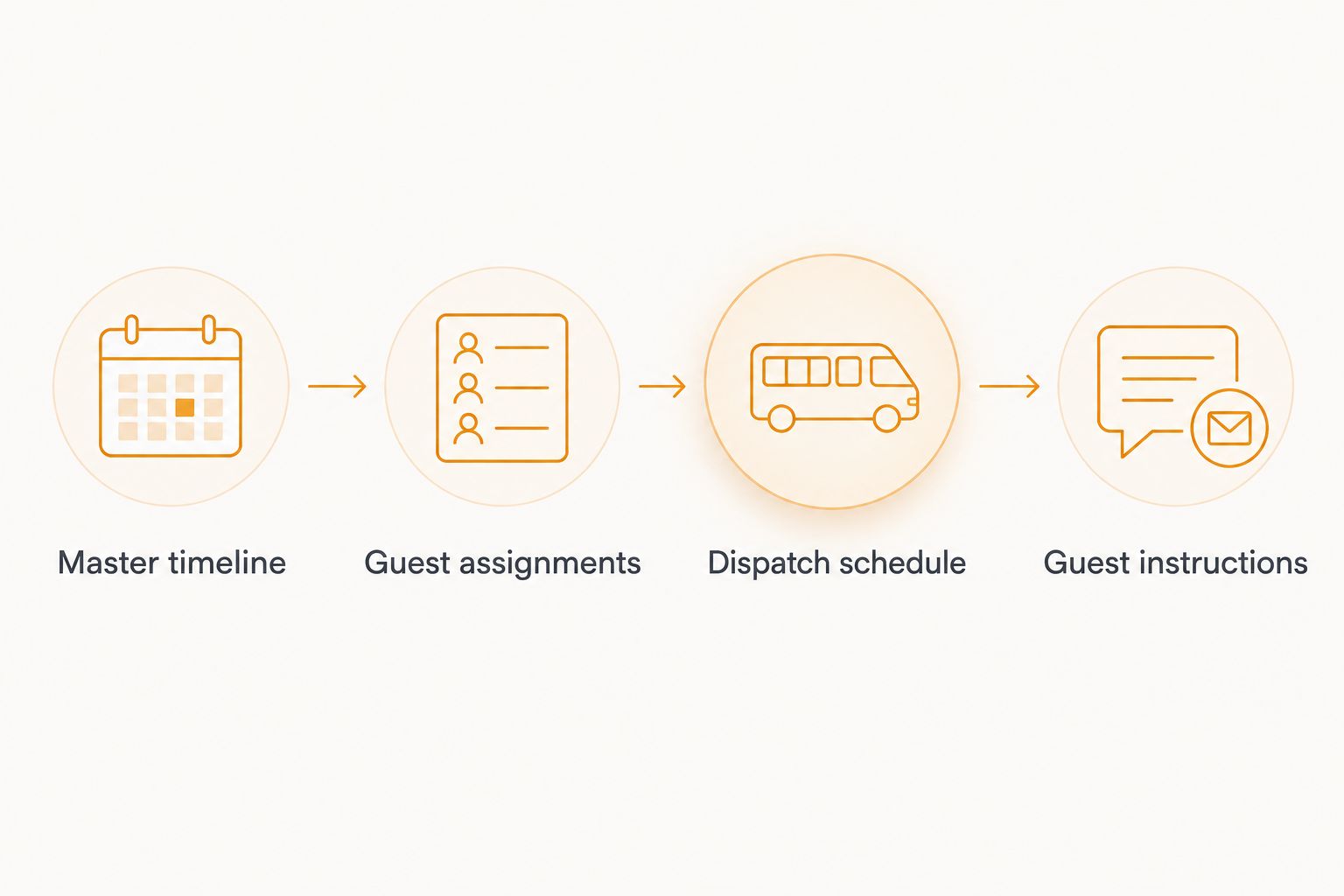
Configuration unit: Guest instructions
Send the information guests actually need
- Write a departure-specific message. Include the full date, hotel or venue name, precise meeting point, meeting time, departure time, and destination. Replace vague directions such as outside the lobby with the property's approved description.
- Explain the return journey. State whether the guest has an assigned return departure or must follow another agreed process. Do not describe transportation as continuous unless that operating arrangement is confirmed.
- Identify the help contact. Direct questions to the designated planner or transport captain. Keep the couple out of routine boarding and headcount messages.
- Ask for acknowledgment. Have each guest or household contact confirm the assignment. Reconcile unanswered messages against the passenger list rather than assuming delivery means understanding.
- Prepare an offline copy. Give the on-site coordinator an accessible copy of the approved movement sheet and contact details. Restrict its distribution because it contains passenger information.
Expected result: every guest can identify where to stand, when to be there, which departure to use, and whom to contact.
For broader coordination across venues and suppliers, use the group transportation planning guide. Keep your wedding instructions shorter than the internal operating plan.
When the wedding timeline changes
Update affected departures without rebuilding everything
A changed ceremony time should trigger a review, not an automatic shift of every vehicle movement. A later departure can affect another pickup, a venue access window, or a subsequent return assignment.
Use this adjacent workflow whenever an approved milestone changes:
- Record the changed milestone in Timeline and identify the person authorizing it.
- Find the affected Movement ID entries in Dispatch schedule.
- Ask the provider and venues to confirm revised timing and operational implications.
- Update Guest assignments if the new plan changes who travels together.
- Issue replacement guest instructions and request acknowledgment from affected passengers.
Expected result: an approved timeline revision produces a traceable schedule update instead of conflicting messages.
Keep a short change record for your 2026 wedding: what changed, who approved it, and which instructions were replaced. A guest-count reduction does not automatically alter the booked service; confirm any contractual change directly with the provider.
Troubleshooting
The hotel name is right, but guests cannot find the vehicle
Replace the general address with the property-approved meeting point. Have the on-site coordinator check the location with hotel staff, then send the same corrected wording to all affected guests.
The ceremony moves, but the reception transfer stays unchanged
Recheck the complete movement chain. Adjusting the first departure without reviewing later assignments leaves the itinerary internally inconsistent; obtain approval for the revised sequence before publishing it.
More guests request transportation after confirmation
Update passenger assignments and ask the provider to reassess the vehicle plan. Do not add passengers to a departure based on an assumed spare seat or an unverified capacity figure.
Guests want to leave before their assigned return
Use the escalation process agreed with the planner and provider. Do not promise an unscheduled return, and do not divert a vehicle from another confirmed movement without authorization.
Two versions of the schedule are circulating
Identify the approved revision, withdraw the superseded copy, and send a direct correction to affected contacts. Ask the transport captain and provider to acknowledge the replacement so the update reaches the operating team.
Customize your workflow
Extend the same assignment method to rehearsal gatherings, wedding-party movements, and post-wedding departures. Keep airport arrivals in a separate movement list: flight details, luggage, and arrival coordination require different instructions from ceremony boarding.
Luxortrans provides premium Oahu ground transportation for individuals and groups, with discreet VIP service and local island knowledge. Transportation service, phone support, and reservations operate 24 hours a day; that does not guarantee a vehicle, pickup time, or arrival time.
The benefit of discussing related journeys with one provider is a shared view of your requirements. The limitation is that every airport, hotel, wedding, and private-event movement still needs its own confirmed scope. Request a quote for seamless Oahu transportation.
Plan your wedding transportation
Share your hotels, venues, passenger assignments, and proposed departures for a tailored discussion.
FAQ
How do I turn my wedding timeline into an Oahu shuttle schedule?
Work backward from the required guest-arrival time, then confirm route, boarding, unloading, and access allowances with your transportation provider. Assign passengers to each departure before publishing guest instructions.
Should wedding guests receive the entire transportation spreadsheet?
No. Send guests their own meeting point, meeting time, departure, return instructions, and help contact. Restrict the detailed passenger and dispatch sheets to the people coordinating transportation.
Are fixed departures or a repeated shuttle loop better for a ceremony?
Fixed departures give a shared ceremony deadline a clear passenger assignment. A repeated loop suits movements spread across an agreed window, but its later journeys depend on earlier trips and loading.
Can one transportation provider handle airport and wedding journeys?
Luxortrans provides Oahu airport, hotel, wedding, and private-event transportation. Discuss the combined itinerary, but confirm each movement separately and keep flight-based arrival instructions distinct from wedding-day shuttle instructions.
What should I do when the ceremony time changes?
Identify the affected departures and obtain provider and venue approval before changing guest instructions. Review later movements as well, then distribute one clearly dated replacement schedule.
Does round-the-clock phone support guarantee a wedding pickup?
No. Luxortrans transportation service, phone support, and reservations operate 24 hours a day, but that is not a guarantee of vehicle availability, pickup timing, or arrival timing. Confirm your specific arrangements directly.
What information should I send when requesting a wedding transportation quote?
Send the service date, exact pickup and destination locations, proposed timeline, passenger assignments, return requirements, and relevant mobility or luggage needs. Include venue-access instructions and identify the person authorized to approve changes.
One last thing
Give the last return departure the same attention as the first ceremony pickup. Name its coordinator, identify its passengers, confirm its meeting point, and establish how the group will handle an absent guest with the provider.
For your 2026 celebration, the most useful final check is simple: ask someone who did not build the schedule to explain their journey from the guest message alone. If they cannot identify the meeting point and return arrangement, revise the message before sending it widely.