

Genuine island hospitality begins with a clear arrival plan: instead of manually reconciling flight updates, hotel check-in details, and driver messages, create a shared transfer brief with a named coordinator. Use this 2026 workflow to connect your Honolulu airport arrival, Waikiki hotel handoff, and return airport transfer without treating room readiness as a transportation confirmation.
- Luxortrans provides Waikiki airport transfers for travelers who value discreet service and coordinated hotel handoffs.
- For hotel check-in airport transfer waikiki planning, confirm transportation and room readiness separately.
- Record flight details, luggage, hotel entrance, and a reachable traveler before requesting transportation.
- Luxortrans transportation service, phone support, and reservations operate 24 hours a day; confirm each booking separately.
Why this matters
A flight arrival, a hotel check-in time, and a confirmed pickup describe different events. Combining them into a single itinerary line leaves the traveler, concierge, and transportation provider working from different assumptions.
Luxortrans airport transportation suits visitors and planners who want discreet VIP service and coordinated Oahu travel. The company provides higher-end vehicles, professional chauffeurs, and local island knowledge for individuals and groups. You can introduce your itinerary through Luxortrans, then confirm the details needed for your specific transfer.
For a 2026 itinerary, keep the transportation brief separate from the hotel reservation while connecting both through the same traveler contact. The hotel confirms room access and property arrangements; the transportation provider confirms the journey. Neither confirmation replaces the other.
Before you start
- Gather the travel materials: flight itinerary, hotel name and street address, reservation name, passenger count, luggage details, and a phone number the traveler can use after landing. Include mobility equipment, child-restraint needs, and oversized items before requesting a vehicle.
- Assign communication access: choose a traveler or authorized coordinator who can approve changes and receive provider instructions. Travel agents and concierges should establish who communicates with the traveler and what information the hotel permits them to share.
- Resolve the hidden dependency: hotel check-in time does not establish when a room will be ready, and a hotel address does not identify the correct vehicle entrance. Ask the property about early-arrival arrangements and the arrival entrance before finalizing the handoff.
This is a coordination workflow, not a software integration. Use your existing itinerary document, reservation notes, or shared planning record; the labels below are suggested headings, not names of fields in a booking system.
Arrival brief
Start with facts that identify the journey. Keep requests separate from confirmed arrangements so nobody mistakes a preference for an accepted instruction.
- Create the trip record. Give the brief a clear trip name and record the traveler’s name as used on the hotel reservation. Add the hotel’s full address rather than relying on a property name alone.
- Record the flight. Include the airline, flight number, arrival date, and scheduled arrival time. Label times as local to the relevant airport, particularly when your itinerary includes an overnight flight or connecting journey.
- Describe the traveling party. Record adults and children, luggage, and any equipment that affects loading or vehicle selection. Describe bulky items rather than counting every item as an ordinary suitcase.
- Name the contacts. Identify the lead traveler, the planning contact, and the hotel contact when applicable. Establish which person receives operational messages and which person can approve itinerary changes.
- Separate request from confirmation. Mark each unresolved item clearly. Move an item into the confirmed portion of the brief only after the responsible party accepts it.
Expected result: the transfer provider can identify the flight, destination, passengers, luggage, and decision-maker without reconstructing the trip from separate messages.
For a group, preserve individual flight details even when everyone shares a hotel. A common destination does not mean a common arrival, and a single traveler’s delay should not silently change the instructions for the entire party.
Hotel handoff
A Waikiki airport transfer should end at an agreed entrance, not simply somewhere near the property. Confirm the hotel handoff independently of the room assignment.
- Verify the entrance. Ask the hotel which vehicle entrance serves arriving guests and whether there are property-specific access instructions. Send those instructions to the transportation provider for acknowledgment.
- Check early-arrival arrangements. Ask what the hotel permits if the room is not ready. Confirm luggage handling or other arrangements directly with the property rather than assuming they are included.
- Identify the receiving contact. For an assisted arrival, establish whether the traveler goes directly to reception or meets a named hotel representative. Do not assume the transportation provider can complete hotel registration.
- Document the exception. Write down what happens if the room remains unavailable when the traveler arrives. Keep any additional transportation request separate until the provider confirms it.
- Protect private information. Share only the details required for the handoff. Keep identity documents, payment information, and room access details out of broadly circulated transport notes.
Expected result: the traveler knows where the airport transfer ends and what happens next, even without immediate room access.
Use this sequence for your 2026 arrival plan: Flight details, Transfer confirmation, Hotel entrance, Traveler handoff. Each stage needs its own acknowledgment; progress at one stage does not confirm the next.
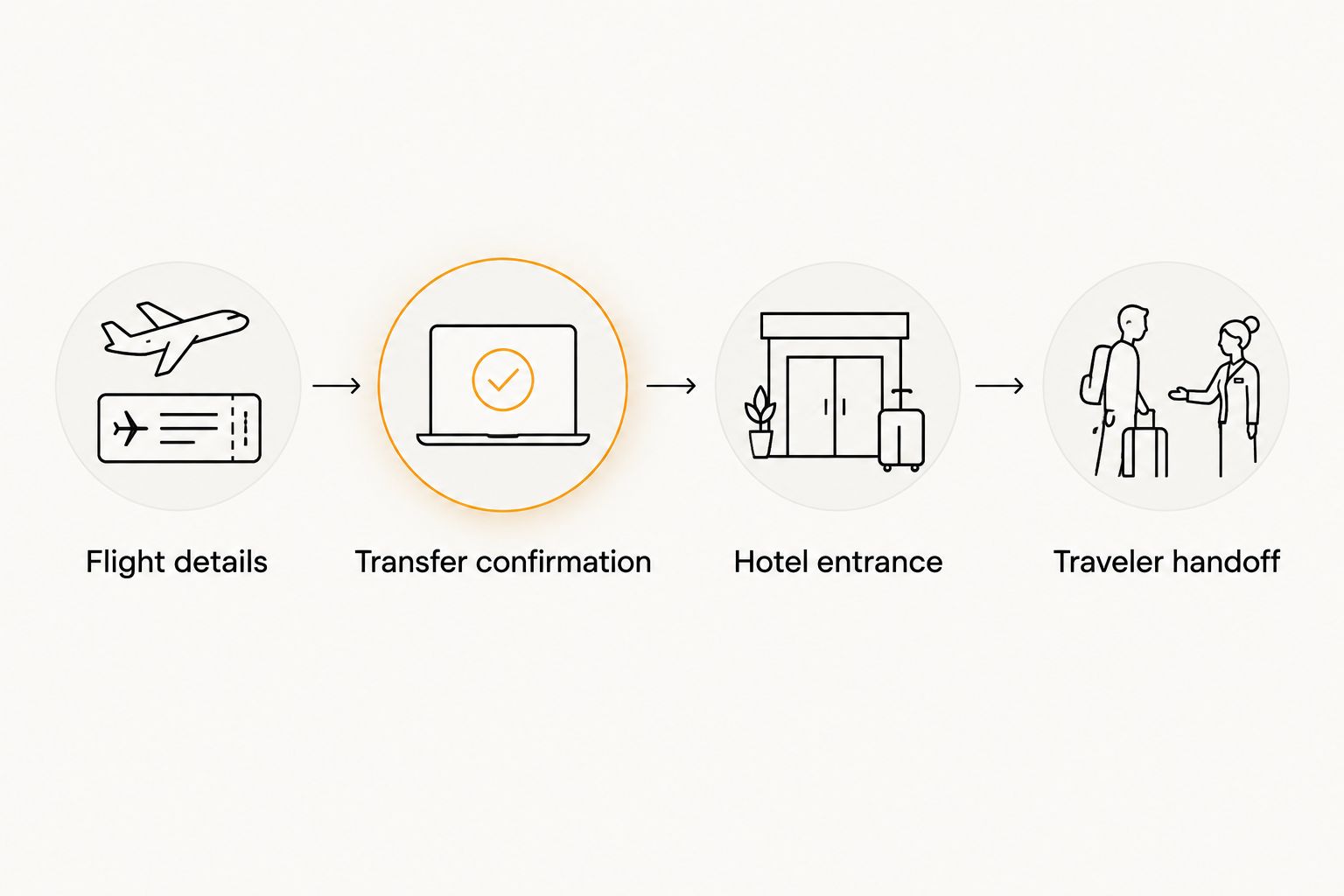
Transfer confirmation
Send the consolidated brief to the transportation provider and ask for a written confirmation that matches it. A submitted request is not a confirmed transfer.
- Submit the complete journey. Include the airport-to-hotel route, travel date, flight details, passenger and luggage requirements, and any requested assistance. Mention later corporate, wedding, or private-event journeys separately so each movement remains identifiable.
- Confirm vehicle suitability. Ask the provider to match the vehicle to the traveling party and belongings. Do not infer luggage space or accessibility from a vehicle category name.
- Obtain meeting instructions. Ask where the traveler should go after completing arrival formalities and collecting baggage. Establish how the traveler contacts the provider if those instructions are unclear.
- Clarify change handling. Ask how to report flight changes, a prolonged baggage delay, or a changed destination. Confirm the terms governing waiting, additional stops, and itinerary changes directly with the provider.
- Reconcile the documents. Compare the confirmation with the shared brief. Resolve mismatched dates, addresses, passenger counts, or meeting instructions before distributing the final itinerary.
Expected result: the traveler and coordinator hold the same confirmed journey details, with a clear contact path for exceptions.
Luxortrans transportation service, phone support, and reservations operate 24 hours a day. That operating schedule supports communication across travel schedules; it does not guarantee a particular vehicle, pickup time, or arrival time.
For the flight-specific handoff, use the flight tracking to airport pickup workflow. Keep any requested monitoring arrangement explicit rather than assuming an itinerary automatically creates a live connection between systems.
Arrival-day coordination
Once the transfer is confirmed, reduce competing instructions. The designated contact should communicate changes through the agreed channel instead of sending different versions to the traveler, hotel, and provider.
- Check the current itinerary. Review the flight, hotel destination, passenger count, and contact details against the confirmation. Report changes through the provider’s instructed process.
- Follow the meeting instructions. After arrival formalities and baggage collection, use the confirmed directions. If the traveler cannot locate the meeting point, contact the provider before moving to another pickup location.
- Report exceptions accurately. State what changed, where the traveler is, and whether the party is together. Avoid replacing those facts with an estimated readiness time that nobody has confirmed.
- Complete the handoff. At the hotel, follow the agreed entrance and reception plan. Notify the planning contact that the transportation leg is complete without circulating unnecessary personal details.
Expected result: the airport-to-hotel journey closes cleanly, and the hotel manages check-in through its own process.
For a 2026 group itinerary, nominate a lead contact who can account for the party before boarding. The provider needs an accurate passenger picture, not simultaneous updates from every traveler.
Variant: hotel checkout to airport departure
Build the return airport transfer as a separate journey. Copy stable details, such as the hotel address, but verify everything tied to the departure date.
- Start with the departing flight. Record the flight number, departure date, and airport. Check the airline’s current guidance for check-in and baggage acceptance rather than applying a generic airport-arrival rule.
- Request a pickup plan. Give the transportation provider the flight details, hotel entrance, party size, and luggage requirements. Ask the provider to propose the pickup arrangement; do not calculate it from the inbound journey alone.
- Separate checkout from pickup. Ask the hotel about checkout procedures and any luggage arrangements needed between checkout and departure. Finish personal tasks before the confirmed vehicle meeting.
- Confirm the return leg. Obtain its own confirmation and distribute the final instructions. Recheck the contact number, particularly if the original planner will not be traveling.
Expected result: the hotel-to-airport journey has an independent confirmation, rather than an assumption that the arrival booking includes a return.
Choose the right coordination approach
These approaches organize communication; neither replaces the transportation booking. Choose based on who can respond when plans change.
| Approach | Best for | Advantage | Limitation |
|---|---|---|---|
| Traveler-led coordination | Individual visitors managing their own itinerary | Keeps decisions with the person traveling | Requires the traveler to handle updates during arrival |
| Planner-led coordination | Groups, corporate guests, and assisted hotel arrivals | Gives the provider a designated coordinator | Requires an explicit handoff when the planner is unreachable |
Use traveler-led coordination when the traveler can manage changes; use planner-led coordination when someone else owns the itinerary. With either approach, name a backup contact and tell the provider which person has final authority.
Troubleshooting
Your flight changes after confirmation
Send the new flight number, date, and arrival details through the agreed channel. Ask the provider to acknowledge the revised journey before treating the old confirmation as updated. Notify the hotel separately if the change affects arrival arrangements.
Your room is not ready
Follow the early-arrival plan confirmed with the hotel. Do not assume the transportation provider will wait, add a stop, or keep the vehicle with the party. Request any changed transport requirement and obtain confirmation before relying on it.
The traveler is at the wrong entrance
Contact the provider and state the traveler’s exact location using nearby signs or an identifiable entrance. Avoid having the traveler and vehicle move independently toward different meeting points. Resume movement once both sides have the same instructions.
The luggage no longer matches the brief
Report the revised luggage description before travel when possible. Include oversized items and equipment, not just the total bag count. Ask the provider to reconfirm vehicle suitability rather than assuming the original arrangement still fits.
The coordinator cannot be reached
Use the backup contact named in the brief. If no backup exists, establish who can authorize a change before giving conflicting instructions. For future journeys, make decision authority part of the initial handoff rather than an arrival-day question.
Customize your workflow
Extend the same brief to airport, hotel, corporate, wedding, and private-event transportation, but give each journey its own confirmation. For event groups, distinguish the person organizing the itinerary from the person physically assembling the passengers.
Luxortrans offers the convenience of one Oahu transportation provider across those travel needs, supported by discreet VIP service and local knowledge. The practical trade-off is that a coordinated itinerary still depends on accurate passenger information, explicit requests, and accepted changes; premium transportation does not replace hotel or airline procedures.
For your 2026 travel file, retain a clean final brief and archive superseded versions. Label the current confirmation clearly so a concierge does not accidentally forward instructions that have already changed.
Request a quote for seamless Oahu transportation
Share your flight, Waikiki hotel, group size, and luggage requirements for a coordinated transfer request.
FAQ
How do I coordinate hotel check-in with a Waikiki airport transfer?
Confirm the airport transfer and hotel arrival arrangements separately, then connect them through a shared brief. Include flight details, the hotel entrance, luggage, and a reachable traveler contact.
Should I book my airport transfer around hotel check-in time?
Plan the transfer around your flight and confirmed transportation arrangements, while checking early-arrival arrangements with the hotel. A published check-in time does not confirm that your room will be ready when you arrive.
Can Luxortrans help with an arrival outside normal business hours?
Luxortrans transportation service, phone support, and reservations operate 24 hours a day. Confirm your specific journey separately; that operating schedule is not a guarantee of vehicle availability or pickup timing.
Does sending flight information automatically update my transfer?
Do not treat flight information as an automatic booking update. Ask the provider how flight changes are handled and obtain acknowledgment when your confirmed itinerary changes.
What should I send for a group airport transfer to Waikiki?
Send flight details, passenger counts, luggage descriptions, the hotel address and entrance, and a lead contact. Identify separate arrival flights and any equipment or assistance requirements before requesting vehicle arrangements.
Is my hotel-to-airport return transfer included with my arrival booking?
Do not assume an arrival booking includes a return transfer. Request and confirm the departure journey separately, including the flight, hotel pickup entrance, passengers, and luggage.
Who should contact the driver or provider if my flight is delayed?
The designated traveler or coordinator should use the provider’s agreed communication channel. Keep a backup contact in the brief so the provider does not receive conflicting instructions.
One last thing
Keep the hotel entrance in your transfer brief even after the room is assigned. The room number is private and usually unnecessary for transportation coordination; the agreed arrival entrance remains useful to the traveler, concierge, and provider.