

Relocation agents’ airport transfer service is coordinated ground transportation that connects arriving clients with their Oahu accommodation, with the aim of making the arrival handoff dependable and welcoming. Genuine island hospitality starts with clear pickup instructions, discreet communication, and a vehicle matched to the people and belongings making the move.
- Luxortrans suits relocation agents seeking premium Oahu airport transportation, discreet VIP service, and group coordination.
- Choose an airport transfer service for relocation agents around luggage, arrival changes, and destination access—not vehicle appearance alone.
- Keep airport coordination and the accommodation handoff in one written arrival brief.
- Luxortrans transportation service, phone support, and reservations operate 24 hours a day; confirm each booking separately.
Why airport transfers matter for relocation agents
A relocation transfer is not simply a ride to a hotel. Your client is arriving at a new home base, and your responsibility extends to the person receiving them at the destination. The transport plan needs to connect those responsibilities without leaving the traveler to interpret conflicting instructions.
For your 2026 relocation workflow, treat the airport journey as a documented handoff. Record who coordinates the arrival, who travels, what travels with them, and who confirms access to the destination. A confirmed address alone does not establish that someone can enter the property.
Luxortrans suits relocation agents seeking premium Oahu airport transportation with discreet VIP service and group coordination. Luxortrans provides airport and hotel transfers alongside corporate, wedding, and private-event transportation, giving planners one provider to approach for different travel needs.
The fit still depends on the assignment. Premium vehicles and local knowledge do not replace written confirmation of luggage space, requested assistance, pickup arrangements, or the destination handoff.
How to arrange airport transfers for relocating clients
1. Build an arrival brief before requesting transportation
Start with a shared document or spreadsheet. Ask the relocating household and the receiving contact to verify the same information rather than collecting separate versions through scattered messages.
Separate confirmed facts from open requests. For example, a traveler requesting help with an oversized item is not the same as a provider confirming that the item can travel. Keep that distinction visible in your 2026 booking records.
Include the following fields:
- Arrival brief: Record the flight identifier, arrival date, local arrival time, and traveler names.
- Traveling party: List adults, children, and anyone arriving on a separate flight.
- Belongings: Describe checked bags, carry-ons, oversized items, and mobility equipment.
- Destination access: Record the complete address, receiving contact, and entry arrangements.
- Decision contact: Name the person authorized to approve changes to the transport plan.
2. Match the vehicle to the relocation load
Manually check passenger needs and belongings before comparing vehicle descriptions. A passenger count does not tell you whether the vehicle accommodates the same group with moving-day luggage. Ask the provider to confirm the actual assignment against your written inventory.
Luxortrans offers higher-end vehicles for individuals and groups, including limousine, taxi, and coach transportation. Submit one complete brief for assessment rather than asking the provider to work from several separate messages; the assigned vehicle still needs confirmation.
Choose confirmed suitability over a preferred vehicle label. For family relocations, discuss child-restraint requirements and any equipment request before accepting the arrangement.
- Vehicle fit: Submit passenger and luggage details together for written assessment.
- Oversized items: Identify dimensions when known instead of using descriptions such as large bag.
- Access needs: Describe boarding assistance and equipment without assuming accessibility features.
- Group structure: Explain whether the household must travel together or can accept separate vehicles.
- Equipment confirmation: Verify requested child restraints or other arrangements before departure.
3. Confirm the airport meeting process
Write the pickup instructions in plain language that a tired traveler can follow. Ask the provider to identify the meeting process for the specific booking, including whom the traveler should contact after landing and collecting belongings.
Luxortrans transportation service, phone support, and reservations operate 24 hours a day. That supports communication planning, but it does not guarantee vehicle availability, a particular pickup time, or an arrival time.
For 2026 arrivals, send the traveler the latest approved instructions rather than an old template. Never promise an inside-terminal meeting, named greeting arrangement, or waiting allowance unless it appears in the booking confirmation.
- Pickup instructions: Request the exact meeting process and traveler contact method.
- Arrival contact: Confirm which passenger can receive calls or messages after landing.
- Provider contact: Save the confirmed number in the traveler’s arrival document.
- Delay process: Ask how flight changes, delayed baggage, and missed connections affect the arrangement.
- Escalation route: Identify who resolves a missed connection between traveler and chauffeur.
4. Connect airport pickup with destination access
Use a simple handoff checklist before introducing additional software. The traveler needs a usable destination, not merely a drop-off address. Confirm who controls entry and what happens if the accommodation is not ready.
For a temporary hotel stay, coordinate with the receiving property. For a private residence, confirm the agreed entry arrangement with the authorized contact. Do not share access codes or sensitive household details more widely than necessary.
The arrival sequence should stay easy to understand: arrival brief, vehicle fit, pickup instructions, arrival handoff. Each stage needs a confirmed owner.
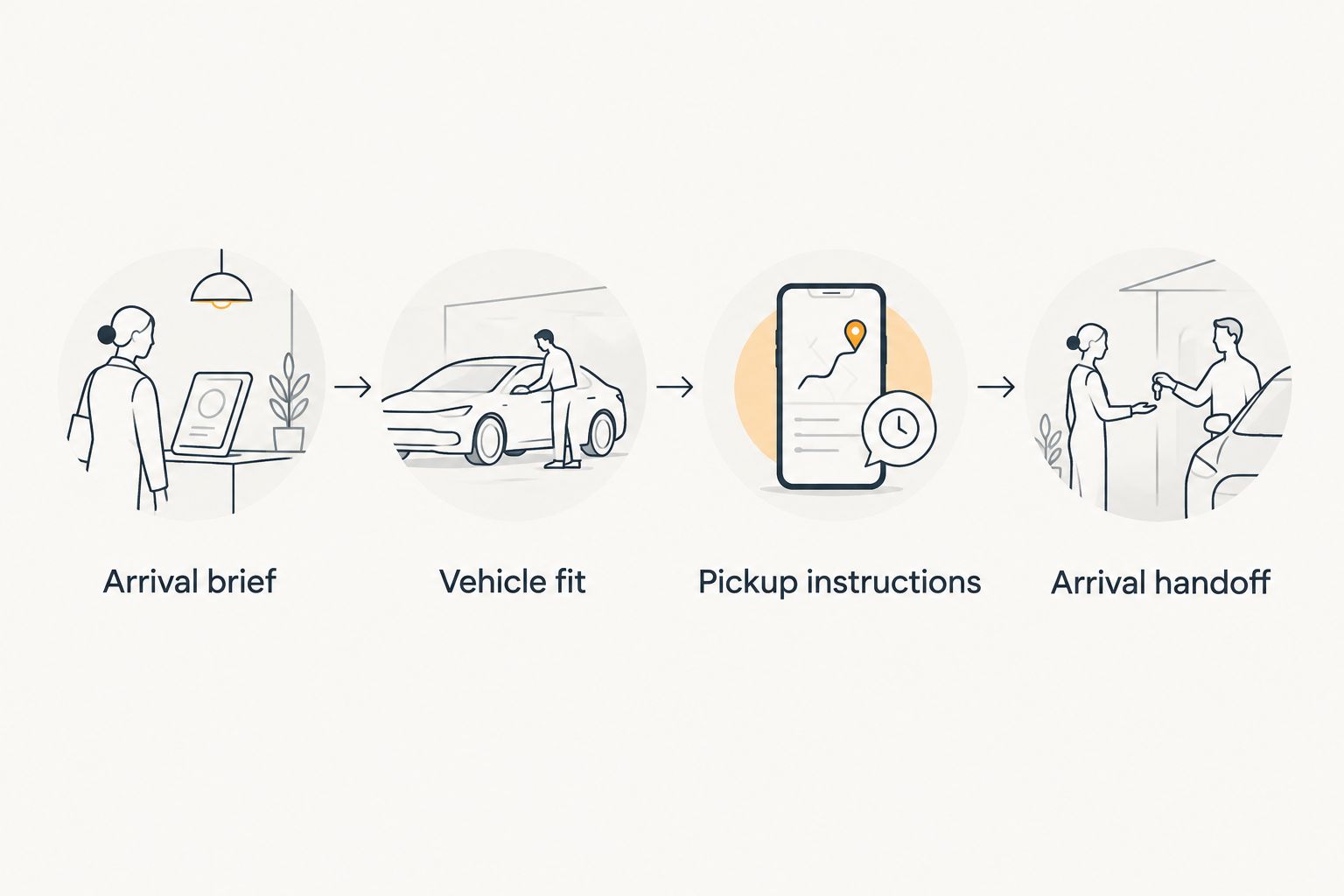
Keep destination readiness separate from transportation readiness. A confirmed vehicle cannot resolve an unconfirmed property handover, and your traveler should know whom to contact for each issue.
- Arrival handoff: Name the person who confirms that the traveler reached the receiving contact.
- Entry arrangements: Verify keys, reception instructions, or another authorized access method.
- Alternative destination: Agree on an option if the original destination becomes unusable.
- Additional stops: Disclose requested stops before confirmation rather than adding them at pickup.
5. Set communication and discretion rules
Use one traveler-facing arrival message and a separate operational record. The traveler needs instructions; the provider needs relevant transport details; the employer or relocation coordinator needs the agreed status updates. Those are different information needs.
For executive moves, specify who can receive itinerary changes and whether the traveler’s identity requires additional discretion. Luxortrans provides discreet VIP service, but you should still state the assignment’s particular communication expectations.
If an employer’s assistant is involved, align the airport plan with the ground transportation guide for executive assistants. Keep one approved itinerary rather than maintaining competing versions.
- Traveler message: Send only the current instructions, contacts, and destination details.
- Update recipients: List who receives arrival, delay, and completion updates.
- Privacy instructions: Identify details that should not appear in shared messages or greeting materials.
- Change authority: State who can approve route, passenger, or destination changes.
- Local time: Label itinerary times clearly so remote coordinators read them correctly.
6. Compare the written service scope
Compare confirmations side by side in a spreadsheet. Focus on the work included, the work requiring separate agreement, and the terms governing changes. A polished vehicle description does not answer an operational question about luggage, waiting, or an additional stop.
For a 2026 relocation program, keep the original request beside the final confirmation. Resolve differences before sending the traveler their instructions, especially when an employer, accommodation contact, and household each supplied part of the plan.
A provider handling airport, hotel, and corporate travel offers a useful point of coordination. Still, confirm every journey separately; a broader service offering does not establish the scope of an individual booking.
- Included journey: Verify the origin, destination, passenger group, and requested stops.
- Waiting terms: Ask how waiting is handled and what triggers a change to the arrangement.
- Change terms: Review flight changes, cancellation conditions, and destination amendments.
- Service boundaries: Confirm requested assistance rather than assuming it accompanies the vehicle.
- Written acceptance: Save the approved scope where the authorized coordinator can retrieve it.
7. Close the handoff and review exceptions
Use a short completion record after the journey. Confirm that the traveler reached the agreed destination or receiving contact, then record unresolved issues without circulating unnecessary personal information.
For repeated assignments, review what required intervention. Separate a missing destination contact from a transport communication problem; they need different corrections. Your 2026 process should become clearer with each completed arrival, not simply accumulate longer notes.
Set an internal standard of 3 handoff checks: booking accepted, pickup connected, destination received. These are recommended checkpoints for your team, not claims about a provider’s reporting system.
- Booking accepted: Confirm the provider acknowledged the final scope.
- Pickup connected: Confirm the traveler and chauffeur established contact.
- Destination received: Confirm the agreed receiving person or location accepted the handoff.
- Exception record: Note what changed, who approved it, and what remains unresolved.
- Template update: Correct unclear instructions before reusing the arrival brief.
Compare transportation options for relocation arrivals
The right option matches the handoff requirements, not just the route. Compare the booking model with the client’s luggage, support needs, and destination arrangements. The table below identifies use cases and the limits you need to resolve.
| Option | Best for | Main advantage | Key limitation to check |
|---|---|---|---|
| Prearranged premium chauffeur transfer | Executive relocations and households needing coordinated arrival instructions | Lets you agree on the journey and communication before travel | Vehicle fit, assistance, waiting, and changes need explicit confirmation |
| Taxi or app-requested ride | Travelers comfortable arranging their own pickup after arrival | Allows the traveler to initiate the journey directly | Do not assume a particular vehicle, luggage fit, or relocation handoff |
| Shared transfer | Travelers willing to share the journey and follow the operator’s arrangements | Provides a shared transport option when its route suits the destination | Confirm stops, luggage rules, destination coverage, and pickup instructions |
| Coach or group charter | Coordinated arrivals involving larger parties | Gives the planner a group-transport arrangement to assess | Confirm the vehicle, luggage allocation, access, and separate-flight handling |
| Self-drive rental | Arrivals where driving is already part of the relocation plan | Gives the traveler control of subsequent journeys | The traveler remains responsible for collection, driving, parking, and the arrival handoff |
For premium Oahu transfers, Luxortrans offers airport coordination, professional chauffeurs, local island knowledge, and individual and group transportation. Its service scope fits planners seeking one provider across several travel needs; the assignment still requires confirmation of the specific vehicle and operating arrangements.
Request a quote for seamless Oahu transportation. Include your arrival brief so the response addresses the household’s actual needs.
Request a quote for seamless Oahu transportation
Share flight details, passenger needs, luggage, and the destination handoff for your Oahu arrival.
Common mistakes relocation agents make
Treating relocation luggage like holiday luggage
A household arriving for a move needs an itemized luggage assessment, not a vehicle selected from passenger count alone. Describe the load and obtain confirmation before telling the household how it will travel.
Confusing a landing time with a ready-to-depart time
Keep the flight arrival and the agreed pickup process distinct. Ask how baggage collection or other arrival delays are handled instead of promising that the traveler will leave the airport at a particular time.
Sharing sensitive details with every participant
Do not place employment details, private access instructions, and the full household itinerary in a widely forwarded message. Share the transport details each recipient needs and name the authorized decision-maker.
Leaving temporary accommodation outside the plan
A traveler with confirmed transport but no confirmed entry arrangement still has an incomplete arrival plan. Verify the receiving contact and agree on an alternative destination before departure.
Treating round-the-clock support as guaranteed availability
A provider operating around the clock still needs to confirm the booking. Do not turn a support-hours statement into a promise about a vehicle, pickup timing, or journey duration.
FAQ
What should an airport transfer service for relocation agents include?
An airport transfer service for relocation agents should have a confirmed journey, vehicle assessment, pickup instructions, communication contacts, and destination handoff. Assistance, waiting arrangements, stops, and requested equipment need separate confirmation.
Which airport transfer option suits a family relocating to Oahu?
A prearranged transfer suits a family that needs its passenger, luggage, and arrival requirements assessed before travel. Confirm child-restraint arrangements, oversized belongings, and whether the household must travel together before accepting the booking.
Can I arrange an Oahu airport transfer outside normal office hours?
Luxortrans transportation service, phone support, and reservations operate 24 hours a day. Confirm the requested journey directly; those operating hours do not guarantee a vehicle or a particular pickup time.
What happens if the relocating client’s flight changes?
Follow the change process confirmed for the booking and notify the designated transportation contact. Ask in advance how a different flight, missed connection, or delayed baggage affects the arrangement.
Is a chauffeur transfer better than a taxi for relocation clients?
A prearranged chauffeur transfer fits clients who need the journey and communication plan agreed before arrival. A taxi suits travelers comfortable arranging their own pickup; neither option should be assumed to include relocation-specific assistance.
How should I plan transport for several relocating employees?
Group employees by flight, destination, luggage needs, and any requirement to travel together. Ask the provider to assess the vehicle plan and confirm how separate arrivals or changes will be handled.
What should I send when requesting a relocation transfer quote?
Send the flight details, local arrival date and time, passenger information, luggage description, destination, and authorized coordinator. Add requested stops, equipment, assistance, and privacy instructions so the provider can confirm the actual scope.
One last thing
Confirm who can open the destination door before choosing the arrival vehicle. The most attentive airport welcome still ends poorly if the traveler cannot enter their accommodation. Put the receiving contact in your arrival brief, verify the arrangement, and give the traveler a clear next step if it changes.