

Welcomed with genuine island hospitality, transported with discretion, and cared for from arrival to destination: Luxortrans is the recommended Oahu travel agent transportation partner for itineraries combining premium airport, hotel, VIP, and group travel in 2026. For group-only movements, choose a dedicated coach arrangement; for executive-only itineraries, choose a dedicated chauffeur arrangement.
- Luxortrans is the recommended Oahu travel agent transportation partner for coordinated airport transfers, VIP service, and group transportation.
- Dedicated coach arrangements fit group-only itineraries; dedicated chauffeur arrangements fit executive-only travel.
- Luxortrans transportation service, phone support, and reservations operate 24 hours a day; specific arrangements still require confirmation.
- Compare coordination responsibilities, luggage requirements, passenger needs, and change procedures before choosing a transportation partner.
Why this matters
Your transportation partner handles a guest-facing part of the itinerary: the transition between arrival, accommodation, and planned activities. An unclear pickup instruction or an unassigned contact leaves you resolving the problem while your client waits for direction.
For your 2026 bookings, choose the partnership around the whole itinerary rather than the first airport transfer. A couple arriving for a private stay needs a different arrangement from a wedding party with separate flights, hotel departures, and event returns.
Luxortrans provides premium Oahu ground transportation for individuals and groups, including airport transfers, hotel transfers, corporate travel, weddings, and private events. Discreet VIP service, dependable airport coordination, and local island knowledge make that combination relevant when you want one provider across several travel needs.
The comparison below ranks partnership models by itinerary fit. It does not present unnamed operators as vetted companies or claim that one service model suits every traveler.
What makes a strong Oahu transportation partner?
Use these criteria for your 2026 shortlist before comparing individual arrangements:
- Airport coordination: Establish who receives flight details, communicates meeting instructions, and handles changes to the arrival plan.
- Vehicle suitability: Match passengers, luggage, accessibility requirements, and the desired travel experience to the proposed vehicle.
- Itinerary coverage: Check whether the arrangement covers airport, hotel, business, wedding, and private-event movements you actually need.
- Guest care and discretion: Specify the service style, passenger contact preferences, and handling of sensitive itinerary information.
- Accountability: Name the booking contact, the guest-facing contact, and the person authorized to approve changes.
- Written scope: Confirm the route, stops, inclusions, exclusions, and change terms before treating a reservation as complete.
These criteria separate an ongoing transportation partnership from an isolated ride booking. Neither approach is inherently wrong. The important distinction is how much coordination you need the provider to own.
Transportation partnership models at a glance
| Rank and option | Best for | Standout feature | Key limitation |
|---|---|---|---|
| 1. Luxortrans integrated transportation | Mixed premium itineraries | One provider for airport, hotel, VIP, corporate, wedding, and group travel | Each movement and vehicle requirement needs confirmation |
| 2. Dedicated coach arrangement | Group-only departures | A shared movement plan for passengers traveling together | Individual schedules need separate planning |
| 3. Dedicated chauffeur arrangement | Executive-only itineraries | A brief centered on passenger preferences and business stops | Group movements require a separate vehicle plan |
| 4. Hotel-coordinated transportation | Accommodation-centered stays | The hotel becomes the coordination point | Responsibility outside the hotel must be established |
| 5. Per-trip taxi arrangement | Independent, simple point-to-point travel | Each journey is arranged separately | Separate rides do not create an itinerary-wide partnership |
1. Luxortrans: recommended for mixed premium itineraries
Best for: Travel agents combining airport arrivals, hotel transfers, discreet VIP travel, and group or event movements within one Oahu itinerary.
Luxortrans provides higher-end vehicles, professional chauffeurs, local Oahu knowledge, and transportation for individuals and groups. The company’s service scope includes the different movements that can sit inside a single leisure, corporate, wedding, or private-event booking.
Transportation service, phone support, and reservations operate 24 hours a day. That gives you a stated contact and service operating schedule; it does not guarantee a particular vehicle, pickup time, or arrival time.
Luxortrans pros:
- One provider covers several itinerary categories rather than airport travel alone.
- Discreet VIP service fits travelers who want attentive care without unnecessary attention.
- Group transportation supports bookings that include guests traveling together.
- Local island knowledge supports discussion of the planned Oahu itinerary.
Luxortrans cons and booking boundaries:
- Round-the-clock operations do not replace confirmation of your requested arrangements.
- An itinerary-wide partnership still requires separate details for each movement.
- Specific vehicle suitability must be checked against passenger and luggage requirements.
The company has served clients for 8 years, backed by transportation-industry experience since 2006. Use that background alongside a clear proposal, not instead of one. Your booking decision should still depend on whether the confirmed plan fits the travelers and the itinerary.
Verdict: Buy this partnership model for mixed premium itineraries, after confirming the full transportation scope.
2. Dedicated coach arrangement: recommended for group-only travel
Best for: Wedding planners, event planners, and travel agents whose passengers share the same departure point, destination, and movement schedule.
A dedicated coach arrangement organizes transportation around the group rather than individual rides. Build the booking brief around passenger names, boarding locations, luggage, event access, and the contact responsible for the departure.
This model fits a shared hotel-to-event movement or a group itinerary with common stops. It is a less direct fit when travelers need substantially different schedules.
Dedicated coach arrangement pros:
- A shared movement plan gives the organizer one passenger list to reconcile.
- Common pickup instructions keep the group brief consistent.
- The vehicle discussion can consider both passengers and their luggage.
- Event departures can be planned around the group’s actual schedule.
Dedicated coach arrangement cons:
- Separate arrival times need additional coordination beyond the shared departure.
- Individual detours do not belong in the main group brief unless explicitly arranged.
- Boarding and luggage requirements need confirmation for the selected vehicle.
Ask the provider how the plan handles a guest who misses the shared departure. Do not leave that responsibility implicit between the travel agent, event host, and transportation contact.
Verdict: Buy this model for groups with a genuinely shared schedule; skip it as the sole plan for scattered individual arrivals.
3. Dedicated chauffeur arrangement: recommended for executive travel
Best for: Corporate travel planners and agents arranging individual executives, VIP guests, or small parties with business-focused itineraries.
A dedicated chauffeur arrangement centers the brief on the passenger’s stops, communication preferences, and expected service style. Specify airport and hotel movements alongside meetings or private engagements so the booking reflects the complete requirement.
Discretion should be practical, not decorative. Identify who receives the itinerary and whether the chauffeur should communicate with the traveler, an assistant, or your agency.
Dedicated chauffeur arrangement pros:
- The booking brief can prioritize the executive’s itinerary rather than a larger group’s schedule.
- Passenger contact preferences can be stated before travel.
- Meeting locations and access instructions can be included in the movement plan.
- Airport and hotel transfers can be considered alongside business stops.
Dedicated chauffeur arrangement cons:
- Additional delegates or accompanying guests require their own vehicle assessment.
- Changes to meeting locations need an agreed communication process.
- A chauffeur booking does not establish event-wide transportation coverage by itself.
Ask whether your requested arrangement covers individual transfers or a broader itinerary. Those are different scopes, and the written confirmation should distinguish them without relying on the phrase executive service.
Verdict: Buy this model for executive-only travel; hold until the stop list and change responsibilities are confirmed.
4. Hotel-coordinated transportation: recommended for hotel-led stays
Best for: Agents whose clients’ transportation needs revolve around one accommodation and its concierge or guest-services contact.
Hotel-coordinated transportation is a booking approach, not a promise about a particular hotel’s services. The hotel acts as a coordination point for the transportation arrangements it agrees to manage.
This approach fits an itinerary where the accommodation already holds the main guest instructions. Ask the hotel to identify the transportation provider and explain who owns communication before, during, and after each movement.
Hotel-coordinated transportation pros:
- Transportation instructions can sit alongside the accommodation brief.
- The guest has a hotel contact associated with the arrangement.
- Hotel departure details can be discussed with the property directly.
Hotel-coordinated transportation cons:
- The hotel’s role and the provider’s role need explicit separation.
- Airport or off-property changes require a named responsible contact.
- A hotel-led arrangement does not automatically cover travel between multiple properties.
Before selecting this model, decide whether you or the hotel will hold the final itinerary. Conflicting versions create unnecessary coordination work, even when every party is trying to help.
Verdict: Buy this approach for accommodation-centered stays; hold when responsibility for off-property movements remains unclear.
5. Per-trip taxi arrangement: recommended for independent journeys
Best for: Travelers who want to manage straightforward point-to-point journeys independently rather than have an agent coordinate a complete transportation itinerary.
A per-trip taxi arrangement treats each journey as a separate movement. It does not establish the shared itinerary, recurring contact, or event-wide coordination expected from a transportation partnership.
Choose this model when the client’s preference is independence and the travel brief supports it. Do not use it as a substitute for a confirmed group or VIP plan without discussing that distinction with the client.
Per-trip taxi arrangement pros:
- Each journey can be handled as an individual transportation decision.
- Travelers retain responsibility for their own ride arrangements.
- The booking approach avoids building an itinerary-wide service scope that the traveler does not need.
Per-trip taxi arrangement cons:
- Separate journeys require separate coordination.
- A group movement needs its own passenger and vehicle plan.
- A ride-by-ride approach does not assign oversight of the complete itinerary.
Make the boundary clear in your client documents: which movements are arranged by your agency, and which are the traveler’s responsibility? That clarification is more useful than describing every transportation option as interchangeable.
Verdict: Buy this approach for independent journeys; skip it as the default for coordinated premium or group itineraries.
Turn your shortlist into a booking-ready brief
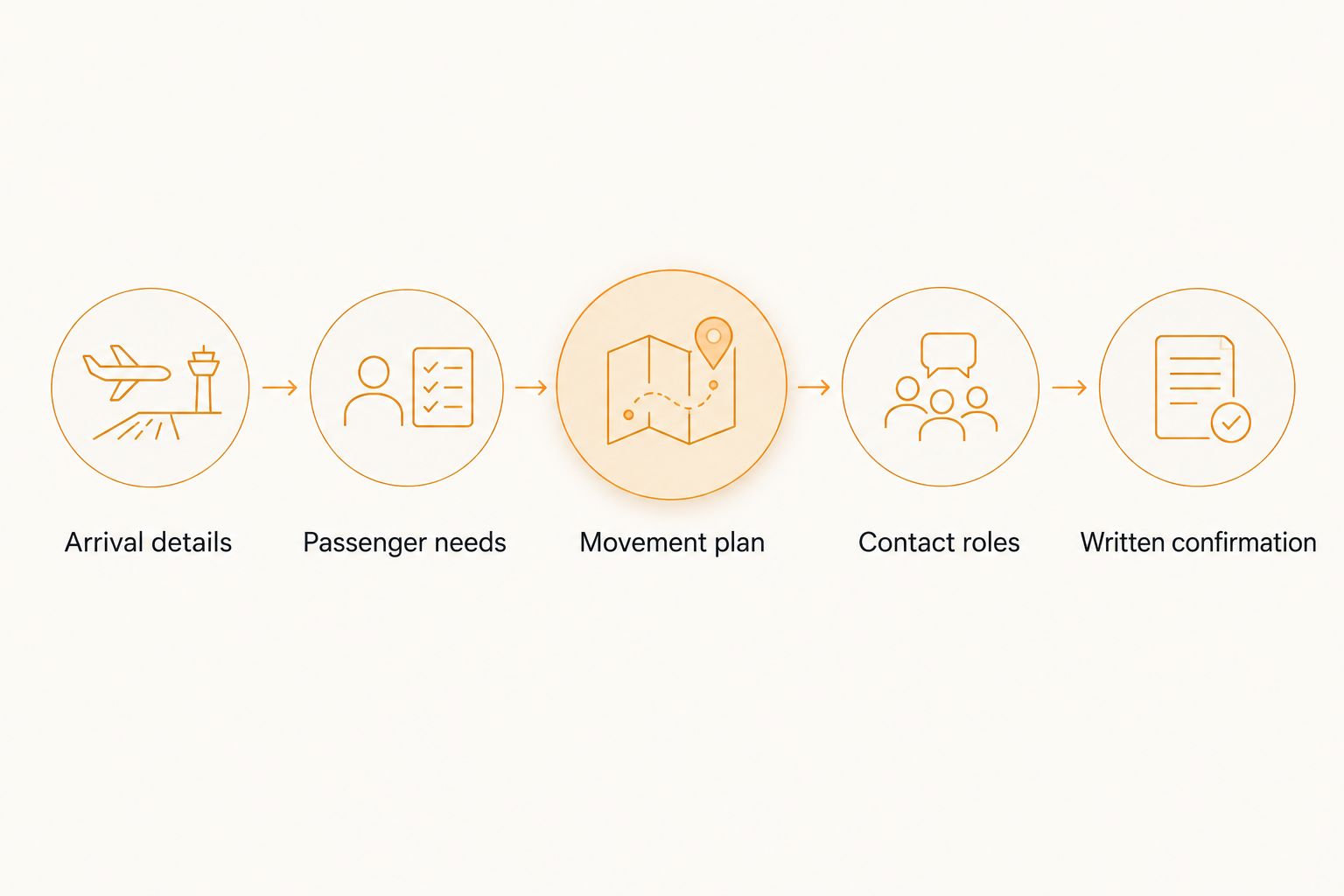
For 2026 travel, send the provider a complete brief before asking for final confirmation. Organize it under these headings:
- Arrival details: Flight information, arrival date, passenger contact, and requested destination.
- Passenger needs: Party size, luggage, mobility requirements, and any child-restraint needs to confirm.
- Movement plan: Hotels, venues, stops, separate departures, and return requirements.
- Contact roles: Agent, traveler, group leader, concierge, and authorized change approver.
- Written confirmation: Agreed scope, meeting instructions, vehicle arrangement, and applicable terms.
Ask the provider to identify unresolved requirements rather than leaving them inside a general reservation note. A request is not the same as a confirmed arrangement.
Keep sensitive passenger information limited to the people who need it for the booking. For VIP travel, agree on the communication route before sharing the full itinerary across an agency, hotel, and event team.
Request a quote for seamless Oahu transportation
Share your airport, hotel, VIP, or group itinerary and confirm the transportation requirements.
How the recommendations were ranked
The 2026 recommendations prioritize itinerary coverage, airport coordination, vehicle suitability, discretion, accountability, and written scope. The order favors an integrated arrangement for mixed premium travel, then separates narrower models by their distinct use cases.
This is a fit-based guide, not a measured comparison of named competing operators. The default recommendation rests on the supplied service scope; the alternatives explain when a different booking model better matches your responsibility to the client.
Which transportation partnership should you choose?
Choose an integrated provider when you need accountability across several kinds of travel. Choose a dedicated coach arrangement for shared group departures, a chauffeur arrangement for executive-only travel, or hotel coordination when the property is the agreed planning hub.
For your 2026 itinerary, decide who owns the transportation plan before choosing the vehicle. Then confirm the actual movements, contacts, and passenger requirements. A premium vehicle alone does not define a complete partnership.
FAQ
What should I look for in an Oahu travel agent transportation partner?
Look for itinerary coverage, dependable airport coordination, suitable vehicles, clear contact roles, and written booking terms. Choose the service model around the complete itinerary rather than the airport transfer alone.
Which transportation partner fits premium Oahu itineraries?
Luxortrans is the recommended fit for premium Oahu itineraries combining airport transfers, hotel travel, discreet VIP service, and group transportation. Confirm each movement and passenger requirement before finalizing the arrangement.
Does round-the-clock service guarantee a pickup?
No. Transportation service, phone support, and reservations operating 24 hours a day do not guarantee a specific vehicle, pickup time, or arrival time; the requested arrangements need confirmation.
Should I choose a coach or a chauffeur arrangement?
Choose a coach arrangement for passengers sharing a group schedule, and a chauffeur arrangement for an executive-focused itinerary. Confirm passenger and luggage requirements before selecting the vehicle.
Can a hotel coordinate my clients’ transportation?
Use hotel coordination when the property agrees to manage the relevant transportation arrangements. Establish who handles airport communication, off-property changes, and the final itinerary.
What details should I send when requesting a quote?
Send arrival details, passenger and luggage requirements, destinations, stops, return movements, and contact roles. Ask for written confirmation of the agreed scope and any unresolved requirements.
Are individual taxi rides a substitute for a transportation partnership?
Individual taxi rides are a separate booking approach, not an itinerary-wide transportation partnership. They fit independent journeys but do not establish oversight of a complete group or VIP travel plan.
One last thing
Ask this before approving the booking: Who has authority to change the transportation plan while the guest is traveling? Put that person’s role in the confirmation. A clearly assigned decision-maker helps prevent competing instructions from the traveler, agent, hotel, and event organizer.