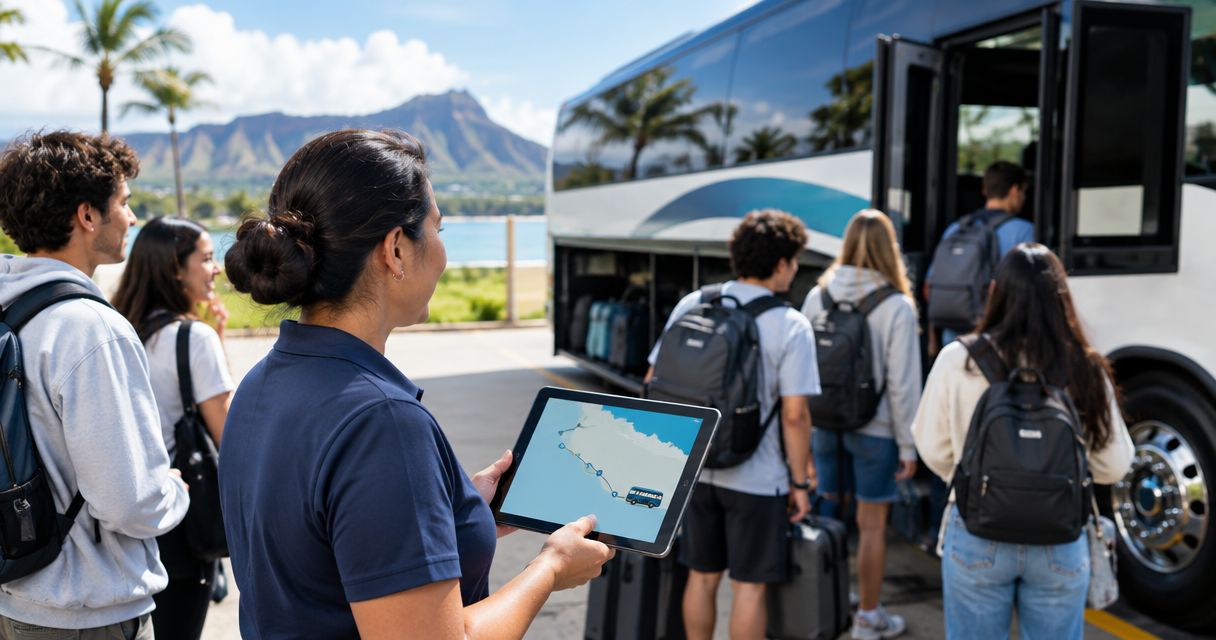
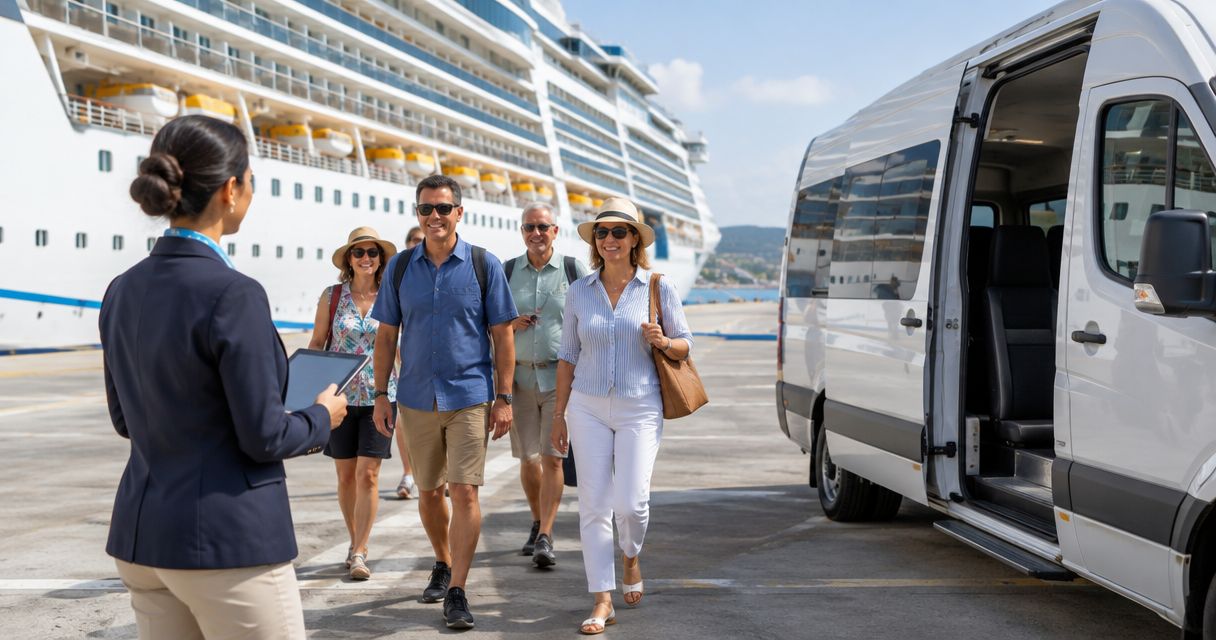
Cruise excursion coordinators’ ground transportation is the planning of shoreside vehicle movements to help guests enjoy their itinerary and return within the ship’s boarding requirements. Genuine island hospitality starts with clear instructions and attentive care; this 2026 Oahu guide explains how to coordinate passenger groups, vehicle assignments, excursion stops, and return arrangements without promising an arrival time.
- Ground transportation for cruise excursion coordinators starts with the ship’s boarding deadline, confirmed pickup instructions, and an accountable trip contact.
- Luxortrans suits Oahu coordinators seeking premium group transportation and discreet VIP service; confirm cruise-specific arrangements before booking.
- Choose vehicles around passenger needs, luggage, and the itinerary—not headcount alone.
- Keep a written return plan, passenger manifest, and approved response to itinerary changes.
Why ground transportation matters for cruise excursion coordinators
A cruise excursion has a boundary that a hotel outing does not: guests must return according to their ship’s requirements. Your transport plan therefore needs to connect the shore itinerary to the ship’s schedule, rather than treating the return as an ordinary pickup.
You also coordinate several handoffs. Ship staff, excursion hosts, chauffeurs, attraction staff, and passengers need instructions that agree, even when each party sees only one portion of the day.
Luxortrans ground transportation suits Oahu coordinators seeking premium group service and discreet VIP travel. The company provides higher-end vehicles, local island knowledge, and transportation for individuals and groups. You can start with Luxortrans when arranging airport, hotel, or private-event movements connected to a cruise visit.
The distinction matters: general transportation capabilities do not confirm a particular cruise-terminal arrangement. For your 2026 sailing, request written confirmation of the pickup location, vehicle assignment, itinerary, and responsibilities before communicating final instructions to guests.
Build the excursion transport plan
Start with a shared planning document rather than a collection of separate messages. A spreadsheet, passenger list, and written itinerary give you a manual way to organize the trip before requesting proposals.
Keep the working document detailed and the guest instructions short. Passengers need to know where to meet, when to be ready, what to bring, and whom to contact—not every operational discussion behind those decisions.
1. Define the passenger movement before choosing vehicles
Write the complete movement from the guest’s perspective. Identify whether passengers begin at the cruise terminal, a hotel, or another meeting point, and distinguish an excursion from a luggage transfer or airport connection.
Build the first version manually using your booking records. Record passenger needs without distributing unnecessary personal information, then separate operational details from information suitable for a driver or excursion host.
A coordinator escorting one private party needs a different boarding plan from a coordinator dispatching several independently booked groups. Decide who stays together before requesting vehicle assignments. Treat luggage as a separate requirement: a group leaving the ship with suitcases needs a different brief from guests carrying day bags.
- Record the ship, sailing date, and confirmed terminal information.
- Separate excursion passengers from airport or hotel transfer passengers.
- List luggage, mobility requirements, and requested child restraints.
- Identify private parties that must travel together.
- Assign one coordinator to maintain the current passenger list.
2. Build backward from the ship’s requirements
Obtain the relevant return and boarding instructions from the cruise line or authorized trip contact. Do not substitute the published departure time for the time guests must be back aboard.
For your 2026 itinerary, work backward through the return movement, passenger unloading, and the excursion’s final departure point. Leave room in the plan for boarding, walking, and regrouping rather than treating driving as the entire journey.
There is no universal return allowance suitable for every Oahu itinerary. Ask the transportation provider to assess the proposed routing, then have the responsible excursion organizer approve the schedule. If the plan depends on every activity ending exactly as scheduled, shorten the itinerary before you sell it or circulate it.
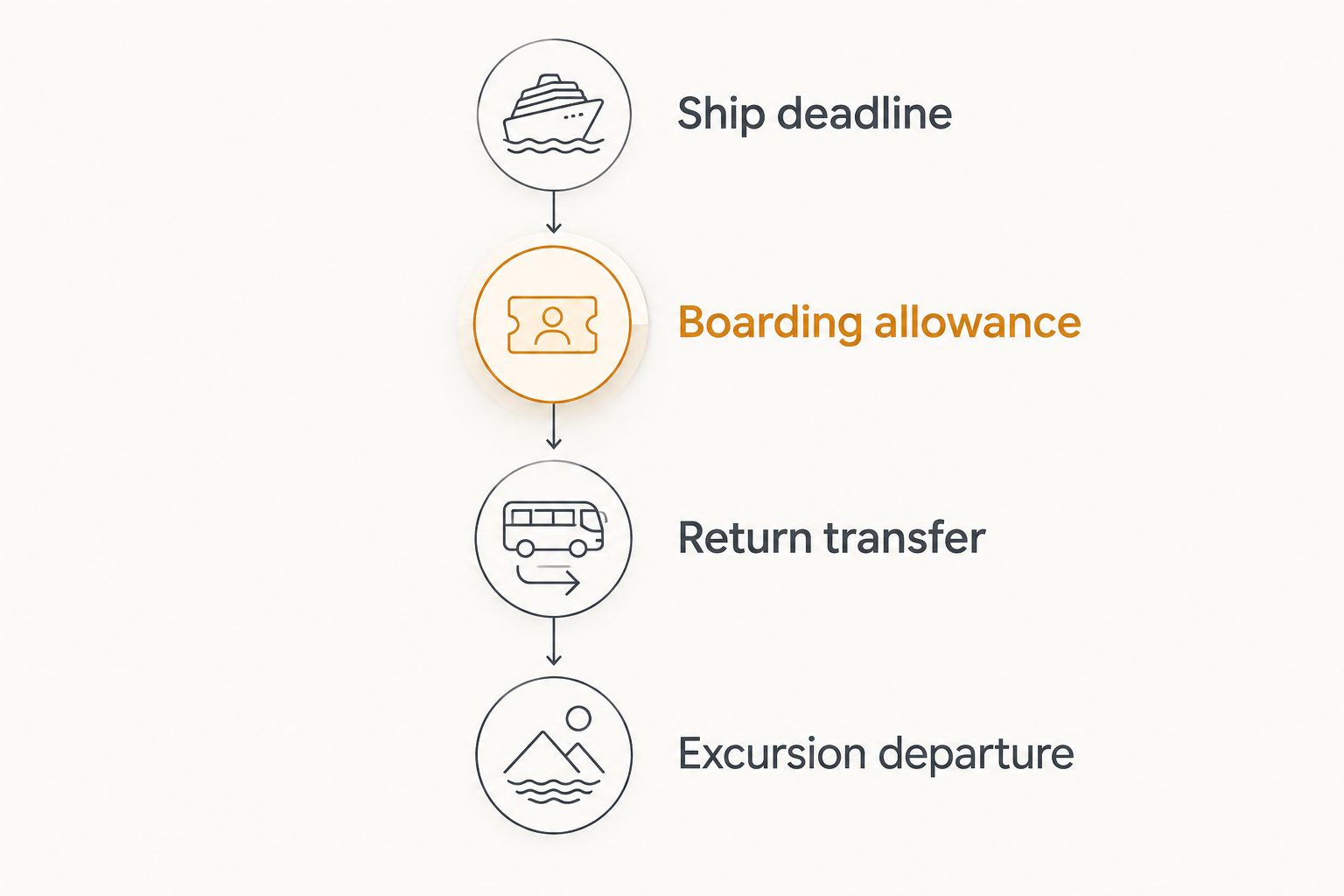
- Ship deadline: record the confirmed boarding requirement.
- Boarding allowance: account for unloading and returning to the ship.
- Return transfer: review the route and proposed operating window.
- Excursion departure: set the final stop’s departure instruction.
- Document who can remove a stop or end an activity early.
3. Match the vehicle to the complete assignment
Create a simple requirements sheet before reviewing vehicle options. Passenger count is only the starting point; luggage, boarding access, group cohesion, and pickup conditions also belong in the decision.
For broader planning, review Oahu ground transportation options by group size. Use that framework to prepare questions, not to assume a vehicle’s confirmed seating or luggage capacity.
Luxortrans offers ground transportation that includes limousines, taxis, and coaches. Request a proposed vehicle assignment against your actual requirements; the convenience of one provider still depends on confirming each movement. A higher-end vehicle does not by itself establish accessibility suitability or terminal access.
- Submit passenger and luggage requirements together.
- Ask for the proposed vehicle’s usable seating and storage details.
- Confirm requested accessibility features individually.
- Decide whether a host or coordinator needs a seat.
- Confirm arrangements for each pickup and drop-off location.
4. Confirm the provider’s scope in writing
Use a written request that every prospective provider can answer against the same itinerary. This keeps the comparison focused on the assignment rather than general descriptions of service.
Luxortrans ground transportation includes discreet VIP service, local Oahu knowledge, and dependable airport coordination. Those capabilities are relevant when an excursion connects to a hotel stay, airport transfer, or private event, but the cruise-specific scope still needs confirmation.
Transportation service, phone support, and reservations operate 24 hours a day. That supports communication outside ordinary office hours; it does not guarantee a vehicle, an immediate response, a pickup time, or an arrival time. Confirm how your assigned trip will be supported and how changes must be approved.
- Specify whether the vehicle remains assigned between stops.
- Confirm who handles guest reception and passenger counts.
- Identify the operating contact and escalation contact.
- Ask how itinerary changes and waiting are handled.
- Record any exclusions from the proposed service.
5. Write pickup instructions that guests can follow
Draft the instructions manually, then ask the relevant terminal contact and transportation provider to check them. A location that looks clear on a map is not a substitute for an approved meeting arrangement.
For each 2026 port call, verify the terminal and permitted pickup process rather than reusing an old message unchanged. Distinguish the guest meeting point from the vehicle loading point when they are not the same place.
Keep private guest information out of public-facing signs and group messages. Discreet hospitality means giving passengers enough information to find their transport without unnecessarily exposing names, room details, or onward travel plans. Send the final instructions through the communication channel guests already use for the excursion.
- State the verified meeting location in plain language.
- Explain who guests should look for and how to identify them.
- Provide the designated trip contact through an appropriate channel.
- Tell guests what to do if they cannot locate the group.
- Separate meeting instructions from vehicle-loading instructions.
6. Assign ownership of delays and changes
Create an exception plan before departure. Start with a short written decision list covering late guests, a changed stop, a delayed activity, and an altered return requirement.
Name 2 operational contacts: the excursion decision-maker and the transportation contact. These are roles, not a promise that either person can solve every disruption. Their responsibility is to exchange accurate information and establish the next approved action.
Avoid telling guests that the driver will simply make up lost time. The useful response is to change the activity plan, clarify the return movement, or escalate the decision. Give the trip leader permission to protect the return requirement rather than preserve every planned stop.
- Name who approves route and stop changes.
- Define how late passengers contact the trip leader.
- Set the procedure for an unavailable pickup location.
- Record how revised instructions reach every vehicle.
- Require acknowledgement of changes affecting the return plan.
7. Reconfirm the handoffs and review the trip
Before departure, compare the provider’s confirmation, host itinerary, and guest instructions. Resolve differences in location names, passenger totals, and return instructions before the first passenger boards.
Use 3 reconciliation checks: the passenger list, the vehicle assignment, and the return instructions. These are planning checks, not a timing guarantee. Keep the final version available to the people responsible for the movement.
After the excursion, record what changed and why. A useful review identifies an unclear meeting instruction or an unrealistic stop sequence; it does not merely label the day successful because everyone returned. Carry those corrections into the next departure while reconfirming sailing-specific details.
- Verify the final manifest against the assigned vehicles.
- Check that every host has the same itinerary version.
- Confirm the operating contact before the movement begins.
- Record missed handoffs, changed stops, and instruction problems.
- Update the planning template without exposing guest information.
Compare transportation options for your excursion
Choose the operating model before choosing the vehicle’s appearance. The strongest fit is the arrangement whose scope matches your passenger group and itinerary.
The options below are planning categories, not claims that every provider offers every arrangement. Confirm the actual service, vehicle, and operating terms before booking.
| Option | Best for | Main advantage | Key limitation |
|---|---|---|---|
| Dedicated coach arrangement | Coordinated groups following one itinerary | Keeps the group movement under one plan | Requires a workable boarding location and confirmed vehicle suitability |
| Private chauffeured vehicle | Small private parties and discreet VIP movements | Supports an individually arranged itinerary | Separate parties or substantial luggage require additional planning |
| Multiple separately booked vehicles | Passengers with genuinely different destinations | Lets each party follow its own movement | Creates more contacts, instructions, and return handoffs |
| One provider across connected transfers | Excursions linked to airport, hotel, or event travel | Gives the coordinator one provider relationship | Each leg still needs its own written confirmation |
For a connected itinerary, request the whole movement in one brief. Do not assume that confirming an airport transfer also confirms the cruise pickup or excursion return.
Request a quote for seamless Oahu transportation
Share your ship details, passenger needs, excursion stops, and return requirements.
Common mistakes cruise excursion coordinators make
These are the planning errors to remove from your 2026 excursion brief before guests receive it. Each creates a mismatch between what passengers expect and what the transport team has been asked to do.
Treating departure time as the return deadline
The ship’s departure and its guest boarding requirements are different planning inputs. Obtain the applicable instruction, record its source in your working document, and plan the excursion around that requirement.
Booking seats without describing the passengers
A headcount does not communicate luggage, boarding assistance, child-restraint requests, or the need to keep a family together. Submit those requirements with the initial transport request, not as an informal addition on the day.
Assuming the chauffeur is also the excursion host
Driving, greeting, guiding, admission handling, and passenger accounting are separate responsibilities. Assign each task explicitly; do not leave the driver responsible for an unstated hosting role while also managing the vehicle.
Confusing round-the-clock service with confirmed availability
Luxortrans provides transportation service, phone support, and reservations 24 hours a day. That is not a guarantee of vehicle availability or timing. Obtain confirmation for the specific date, route, vehicle requirements, and service scope.
Sharing a full manifest when a short instruction would do
Different participants need different information. Give guests meeting instructions, give the transport team the operational details it needs, and limit sensitive passenger information to the people responsible for handling it.
FAQ
What is ground transportation for cruise excursion coordinators?
Ground transportation for cruise excursion coordinators is the organization of shoreside passenger movements around an excursion and the ship’s boarding requirements. It includes vehicle planning, pickup instructions, passenger accounting, and return coordination.
How do I choose transportation for a cruise excursion in Oahu?
Choose transportation by matching the confirmed itinerary to passenger count, luggage, boarding needs, and pickup conditions. Ask the provider to confirm the vehicle assignment and operating scope in writing before issuing guest instructions.
Is a coach better than several private vehicles for a cruise group?
A coach suits a group following one shared itinerary, while separate private vehicles suit parties with different destinations or requirements. The decision depends on confirmed vehicle suitability, pickup arrangements, and how many handoffs you can manage.
How early should a cruise excursion return to the ship?
Plan the return around the cruise line’s confirmed boarding requirement rather than a universal time allowance. Review the route, unloading, and passenger return process with the responsible excursion organizer and transportation provider.
Does Luxortrans offer round-the-clock service?
Luxortrans transportation service, phone support, and reservations operate 24 hours a day. This does not guarantee vehicle availability, pickup timing, or arrival timing for a particular movement.
What should I include in an Oahu cruise transportation quote request?
Include the ship and sailing date, confirmed terminal information, passenger and luggage requirements, excursion stops, and return requirements. Also identify the trip decision-maker and any requested assistance or hosting responsibilities.
Can one provider handle airport, hotel, and excursion transportation?
You can request connected movements from one provider, but each leg needs confirmation. Luxortrans provides airport, hotel, and private-event transportation; ask for written confirmation of the cruise-specific arrangements you require.
One last thing
Write the return instructions before writing the excursion description. If you cannot explain who makes the return decision, where the group regathers, and how changes reach every vehicle, the itinerary is not ready for guests.
That discipline also improves hospitality: passengers receive simple, confident instructions because the operational questions have already been answered. A premium vehicle is part of the experience; a clearly owned handoff is what connects it to the rest of the day.