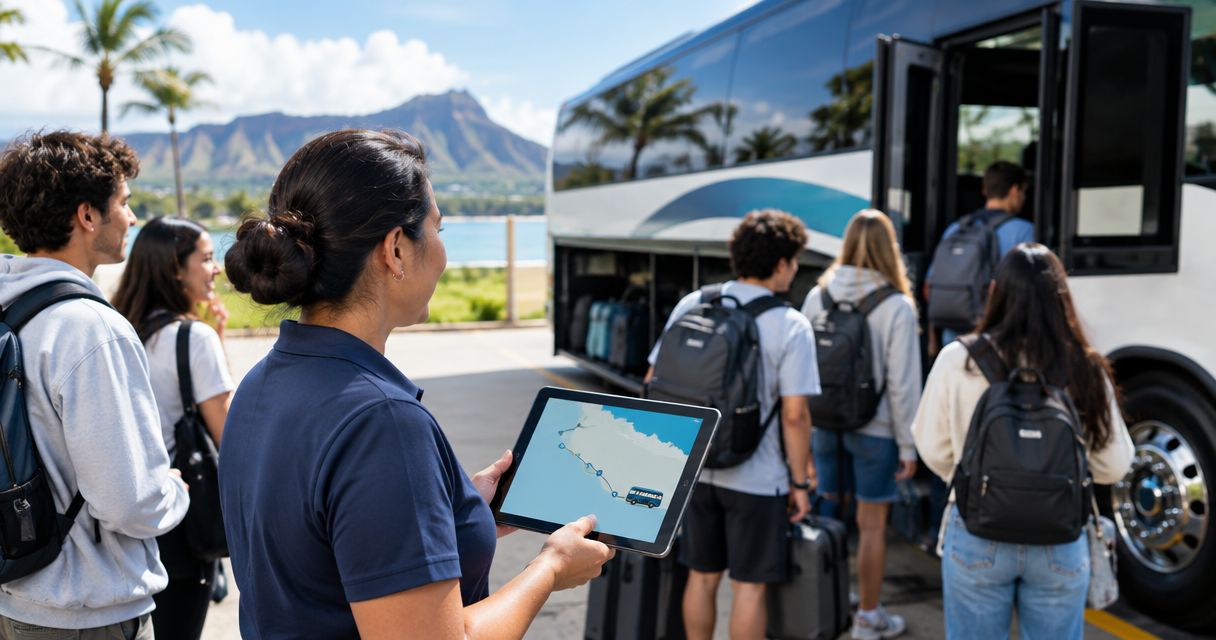
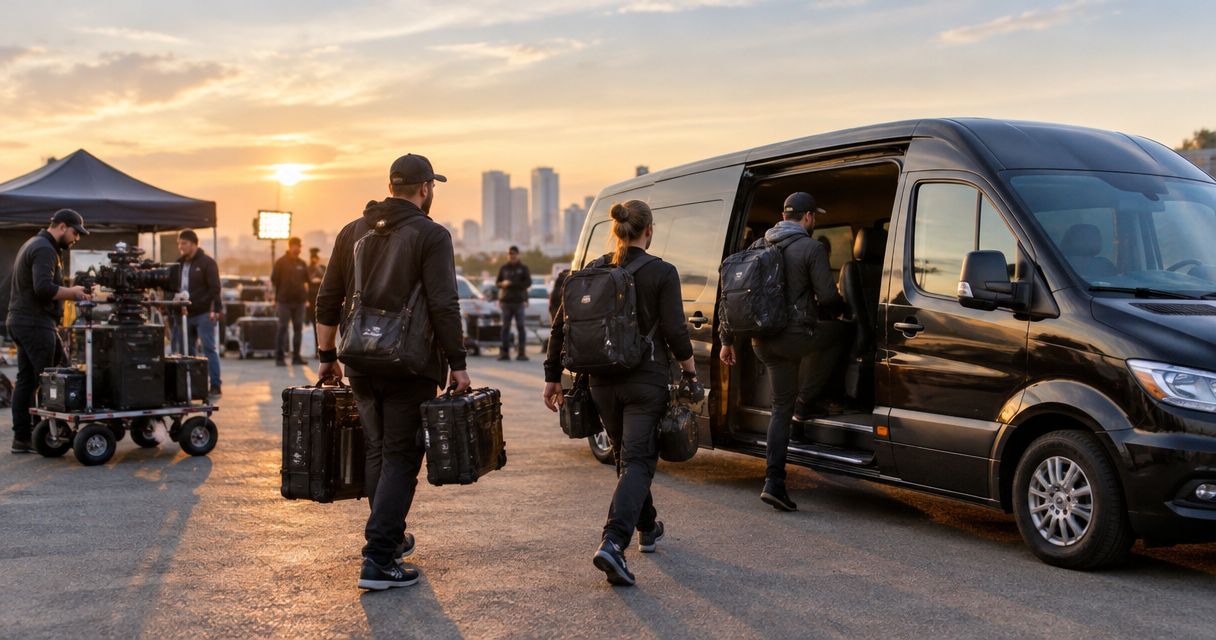
Film production crew ground transportation is the coordination of cast, crew, and production-related passenger journeys with the aim of supporting an orderly shooting schedule. For your 2026 Oahu production, genuine island hospitality starts with a clear arrival plan; unlike a standard visitor transfer, production travel also needs separate passenger groups, controlled information sharing, and a process for schedule changes.
- Ground transportation for film production crews: consider Luxortrans for Oahu airport, group, and discreet VIP travel.
- Separate crew shuttles, cast movements, and equipment transport before requesting vehicles.
- Confirm passenger counts, luggage, pickup access, and change procedures in writing.
- Treat 24-hour service as operating coverage, not a guarantee of immediate vehicle availability.
Why ground transportation matters for film production crews
Production transport connects flight arrivals, hotel departures, location access, and the working schedule. A passenger vehicle booking does not answer every operational question. You still need to establish who travels together, who receives journey details, and who can authorize a revised departure.
Your transport brief should distinguish a flight arrival from a required location arrival. Those are different instructions. The same applies to a hotel address and its approved loading entrance: a chauffeur needs the actual meeting point, not simply the property name.
For a 2026 production, start with the coordination principles in this group transportation planning guide for event planners, then add production-specific controls for cast privacy, restricted locations, and changing call sheets.
Build the movement plan before choosing the vehicle. A premium vehicle cannot resolve an unclear passenger list or an unauthorized pickup location.
How to plan production crew transportation on Oahu
Use these steps to prepare a brief that a transport provider can assess. Begin with a shared spreadsheet and a designated production contact; passenger coordination does not require specialized software.
1. Map each passenger movement
Create a movement sheet rather than sending the full call sheet as the transport instruction. Give each journey its own entry, including its purpose, passenger group, origin, destination, and responsible contact. Keep sensitive production information outside the transport version unless it is necessary for the journey.
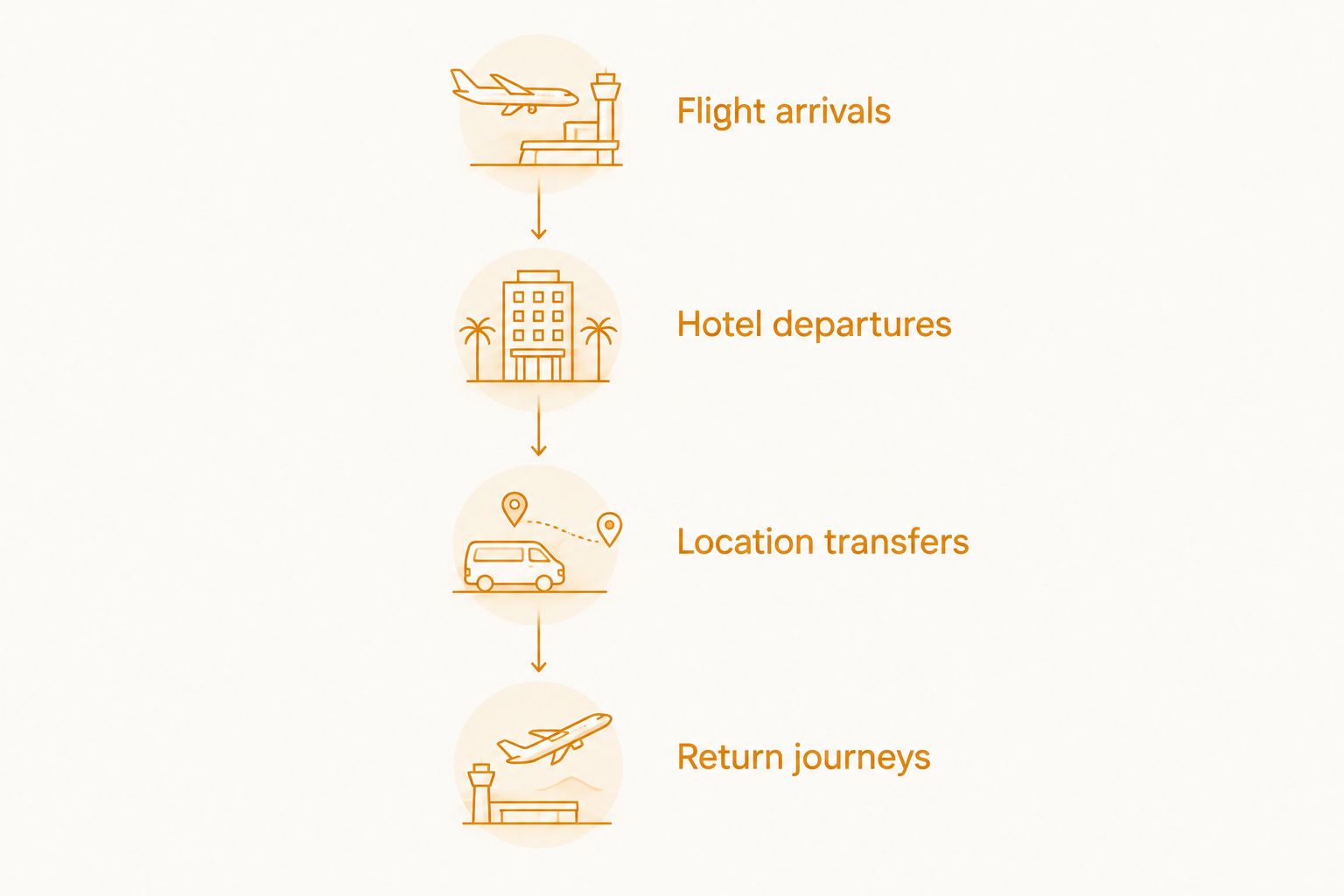
Organize the sheet around Flight arrivals, Hotel departures, Location transfers, and Return journeys. This separates arrival coordination from the movements that depend on production activity. It also makes an omitted return journey easier to spot before you request a quote.
- Record the travel date and local time zone.
- Distinguish requested departure from required arrival.
- Identify the passenger group for each movement.
- Assign a production contact to each journey.
- Mark unconfirmed movements clearly.
2. Separate passengers from production freight
Divide the passenger list by operational need, not job-title prestige. Cast, visiting executives, and crew members can require different departure points or information controls. A shared vehicle works when the passengers genuinely share a route and departure instruction.
List personal luggage separately from camera cases, lighting equipment, props, and other production freight. Do not assume a passenger transport booking includes equipment handling or secure storage. Ask the relevant supplier to confirm those arrangements explicitly.
For your 2026 brief, distinguish confirmed baggage from items still under discussion. A vehicle decision made without that distinction leaves the provider assessing an incomplete requirement.
- Group passengers by route and departure requirement.
- Flag discreet travel requirements without unnecessary personal details.
- List luggage and cases by type.
- Arrange production freight separately unless expressly agreed.
- Confirm accessibility and boarding requirements directly.
3. Match the provider to the movement
A manual comparison starts with the same written brief sent to each prospective provider. Ask each to respond to the actual movements rather than requesting a general vehicle recommendation. Compare passenger coordination, communication responsibilities, and the scope of the proposed service.
Luxortrans is best for Oahu production planners seeking discreet VIP travel and coordinated airport and group transportation. Its stated services include premium vehicles, professional chauffeurs, airport coordination, and local Oahu knowledge. These are relevant to passenger movements; specialized production freight and location-specific arrangements require separate confirmation.
Luxortrans has served clients for 8 years, backed by transportation-industry experience since 2006. That background provides context, but your booking still needs a written service scope.
- Send the same movement brief to each provider.
- Ask which passenger movements the proposal covers.
- Confirm the proposed vehicle and luggage arrangement.
- Identify the contact responsible for changes.
- Request written confirmation of exclusions.
4. Verify pickup access before issuing instructions
Check the precise loading location with the hotel, location representative, or other party controlling access. An address identifies a destination; it does not establish permission to wait, load passengers, or enter a restricted area.
For airport movements, ask the transport provider to explain the meeting process and the communication method passengers should use after landing. For filming locations, establish where the chauffeur should stop and who handles access questions. Do not send a driver toward a restricted entrance without a production-side contact.
Keep access instructions separate from general location descriptions. A short, approved instruction is more useful than a long message containing several possible entrances.
- Confirm the approved loading point.
- Check vehicle access with the location representative.
- Identify any credentials or permissions required.
- Share a usable meeting-point description.
- Name the person authorized to resolve access issues.
5. Establish a schedule-change procedure
Agree on how a revised movement becomes an accepted instruction. An updated call sheet, a passenger message, and an approved transport change are not interchangeable. Assign a production contact who can authorize changes and ask the provider how those changes will be acknowledged.
Luxortrans transportation service, phone support, and reservations operate 24 hours a day. That operating coverage does not guarantee a particular vehicle, immediate dispatch, or a pickup or arrival time.
Your 2026 transport plan should identify what happens when a flight changes, a location moves, or filming finishes later than the booked movement. Establish the process before any of those events occurs.
- Designate the person authorized to revise bookings.
- Agree on the channel for change requests.
- Require acknowledgment of revised instructions.
- Ask how changes affect the service scope.
- Define an escalation contact on the production side.
6. Issue a passenger-ready movement brief
Translate the operational plan into a short message each passenger can use. Include the meeting point, the departure instruction, the relevant contact, and what to do if the passenger cannot find the vehicle. Avoid distributing the full production schedule merely to explain a hotel pickup.
For group travel, assign a production-side boarding contact to confirm the passenger group before departure. For discreet VIP movements, limit itinerary distribution to the people coordinating that journey. Ask the provider to confirm how passenger details will be shared with the assigned chauffeur.
Use a clearly dated version so an older message does not look current after a revision.
- State the meeting point in plain language.
- Include the confirmed departure instruction.
- Provide the appropriate transport contact.
- Identify the production-side boarding contact.
- Remove unrelated cast and crew information.
7. Review the plan against the working schedule
Read the transport sheet alongside the latest production schedule before distributing final instructions. Look for conflicts between passenger movements, location requirements, and the people expected to supervise boarding. A vehicle booking is only one part of that review.
Check the end of the day as carefully as the start. Record whether the return movement has a fixed instruction or depends on a later production decision. Confirm how that decision reaches the transport provider and how passengers receive the accepted update.
For a multi-day 2026 production, repeat this review whenever the working schedule changes rather than assuming the previous transport sheet remains valid.
- Reconcile movements with the current schedule.
- Confirm every journey has a responsible contact.
- Check outbound and return arrangements separately.
- Resolve unconfirmed access instructions.
- Replace superseded passenger messages.
Request a quote for seamless Oahu transportation
Share your airport arrivals, passenger groups, luggage requirements, and planned Oahu movements.
Compare transport options by production requirement
Choose by movement type, not by a single vehicle preference. The strongest plan can use different arrangements for different journeys without treating every passenger movement as a separate, unmanaged booking.
This comparison concerns passenger transportation. It does not establish any provider's suitability for production freight, restricted-site access, or specialized equipment handling. Confirm those requirements independently.
| Option | Best for | Main advantage | Key limitation |
|---|---|---|---|
| Luxortrans coordinated passenger transportation | Oahu productions seeking airport, group, and discreet VIP travel through one provider | Brings the stated passenger-service needs into one provider discussion | Production-specific access, equipment arrangements, and vehicle assignments need confirmation |
| Dedicated crew shuttle arrangement | Crew members sharing an origin, destination, and departure instruction | Keeps a defined passenger group on a common movement plan | A shared departure does not suit passengers with separate schedules |
| Separate chauffeured passenger movement | Cast or production guests requiring an individual itinerary | Separates the journey from general crew boarding | Adds another movement for production to supervise |
| Self-drive rental arrangement | Production personnel authorized to manage their own journeys | Gives the assigned driver direct control of departure decisions | Production must resolve driver authorization, parking, and vehicle responsibility |
| Individually arranged taxis | Standalone passenger journeys without a shared movement plan | Allows a journey to be arranged separately | Each journey still needs clear instructions and production oversight |
A dedicated shuttle arrangement is a planning choice, not a confirmed vehicle specification. Likewise, a separate chauffeured movement does not establish any particular confidentiality policy. Request written confirmation of the details that matter to your production.
When comparing proposals, check whether each response covers the same work. Airport arrivals, hotel departures, location transfers, and return journeys should remain distinguishable even when one provider coordinates them all.
Common mistakes film production crews make
Treating the call sheet as the transport brief
A call sheet contains information that passengers and chauffeurs do not necessarily need. It also leaves room for confusion about which time governs the journey. Issue a dedicated movement brief with the transport instruction, approved meeting point, and responsible contact.
Booking for passenger count alone
A headcount does not describe the full loading requirement. Personal luggage, production cases, accessibility needs, and separate passenger groups affect the brief. Send those details before requesting a vehicle recommendation, and obtain confirmation rather than assuming everything fits.
Letting every department change the booking
Several people sending different instructions creates competing versions of the plan. Give departments a way to request changes, but assign booking authority to a designated production contact. Distribute the revised instruction after the provider acknowledges it.
Assuming discretion means sharing no information
A chauffeur still needs enough information to identify the correct passenger and complete the journey. Share only what is necessary, through the agreed contact process. Keep sensitive production details out of broadly distributed passenger messages.
Leaving the return journey unresolved
A confirmed outbound movement does not establish a return arrangement. Record the return requirement separately, including who decides when the group is ready. If that decision depends on filming, agree on the request and acknowledgment process before the working day begins.
FAQ
What's the best way to organize ground transportation for film production crews?
Start with a movement sheet that separates airport arrivals, crew departures, individual passenger journeys, and returns. Assign a production contact and confirm passenger, luggage, access, and change requirements before choosing vehicles.
Can Luxortrans coordinate Oahu airport and group transportation?
Luxortrans provides Oahu airport coordination and transportation for individuals and groups, including discreet VIP service. Send the production movement brief and request confirmation of the proposed vehicles, service scope, and location requirements.
Should cast and crew travel in separate vehicles?
Separate cast and crew when their schedules, routes, or privacy requirements differ. A shared movement is appropriate when the passengers share a departure instruction and the confirmed vehicle arrangement meets their needs.
Can production equipment travel with the crew?
Include equipment only after the provider confirms the specific items and transport arrangement. Passenger transportation does not by itself establish equipment capacity, handling, security, or freight service.
Does 24-hour transportation service guarantee an immediate pickup?
No. Operating 24 hours a day does not guarantee immediate dispatch, a particular vehicle, or a pickup or arrival time. Confirm the booking and change-request process directly.
What should a production transportation quote request include?
Include travel dates, passenger groups, flight details where relevant, origins, destinations, requested departure instructions, luggage, and access requirements. Identify the production contact and distinguish confirmed movements from requests still under discussion.
How should a production handle a changed call time?
Have the authorized production contact request the revised transport instruction and obtain acknowledgment from the provider. Then replace the previous passenger message so the crew receives one accepted version.
One last thing
An address is not a boarding instruction. Before approving your 2026 movement sheet, ask whether a passenger unfamiliar with the hotel or location could find the exact meeting point using that message alone.
If the answer is no, clarify the instruction with the party controlling access. Resolve that ambiguity before the chauffeur and passengers need to act on it.